
An action title is a slide headline written as one complete sentence that states the slide's conclusion, such as "Churn, not new-customer acquisition, explains most of the revenue gap" instead of "Revenue analysis". Consultants use them because a reader who only skims the headlines should still get the whole argument, and because writing the sentence forces you to decide what the slide actually proves.
This guide covers what makes a good action title, the research behind sentence headlines, a five-step method for writing them, ten before-and-after rewrites with the reasoning for each, a real case where a weak headline buried a critical warning, and a checklist you can apply to your next deck.
What is an action title?
An action title (also called an action headline, assertion headline or message title) is the one sentence at the top of a slide that tells the reader what to conclude. Everything else on the slide, whether a chart, table or diagram, is evidence for that sentence.
| Topic title | Action title | |
|---|---|---|
| Form | A noun phrase | A full sentence with a verb |
| Tells the reader | What the slide is about | What the slide proves |
| Example | "Customer churn by segment" | "SMB churn doubled in 2025 while enterprise churn held flat" |
| Reader's work | Has to study the chart and infer the point | Reads the point, then checks it against the chart |
| Can be wrong? | No, which is the problem | Yes, so it has to be supported |
That last row is the important one. A topic title can't be wrong, so it commits you to nothing. An action title is a claim, and a claim can be checked, challenged and defended. That's the property you want in a business argument.
The practice comes from the top-down structure Barbara Minto set out in The Pyramid Principle: state the point first, then support it. An action title applies that rule to a single slide. Gene Zelazny's Say It With Charts, the long-standing McKinsey reference on business charts, makes a similar point about exhibits: decide the message first, and the message determines both the chart and its title.
Why sentence headlines work: the evidence
There's more behind this than consulting habit.
- Comprehension. In a controlled experiment published in the International Journal of Engineering Education, Joanna Garner and Michael Alley gave engineering students the same lecture on how MRI detects tumours, paired either with conventional slides (topic titles plus bullet lists) or with assertion–evidence slides (a sentence headline plus visual evidence). The assertion–evidence group wrote better explanations, held fewer misconceptions, reported lower cognitive load and recalled more a week later. Washington University's Center for Teaching and Learning summarises the study under a fitting headline: it's the headline that makes the difference.
- Scanning behaviour. Nielsen Norman Group's eye-tracking research on reading patterns shows that readers scan the first lines of content far more than what follows. Executives read decks the same way. They read the top of the slide and decide whether to look further.
- Decision risk. The case below shows the cost when the headline says one thing and the critical evidence sits in the smallest type on the slide.
A real case: the Columbia slide
During the 2003 Space Shuttle Columbia mission, Boeing engineers briefed NASA on whether foam debris that had struck the wing during launch could have damaged the heat-shield tiles. One slide in that briefing has since become a teaching case.
Its headline said that a review of test data showed "conservatism" in the tile-penetration predictions, which reads as reassurance. But the most important fact sat at the lowest level of the bullet hierarchy, in the smallest type: the debris in question was hundreds of times larger than the projectiles in the test database (Edward Tufte puts it at roughly 640 times). In other words, the flight conditions were far outside anything the tests covered.
Tufte's analysis argues that the slide's hierarchy highlighted what managers already believed and let the warning signs drop away. The Columbia Accident Investigation Board went further. In Volume 1 of its report (p. 191) it criticised NASA's "endemic use of PowerPoint briefing slides instead of technical papers" (CAIB, via Tufte).
The lesson for business decks is direct. The headline is the part people act on. If the most important qualification isn't in the title, assume the decision-maker never saw it.
How to write an action title: a five-step method
Step 1: Write the question the slide answers
Before you write the title, write the question the slide answers in one line: "Why did revenue miss plan?" or "Which segment should we enter first?" If you can't state the question, the slide doesn't belong in the storyline yet.
Step 2: State the answer as a full sentence
Answer the question in one sentence with a subject and a verb. Use the specific noun, such as "SMB churn" or "Northern region", not "performance".
Step 3: Add the evidence that makes it true
Put the decisive number or comparison in the sentence: "doubled", "3 of 5 plants", "€4.2m of the €6m gap". A number turns an opinion into a claim someone can check. Only use numbers the slide body actually shows.
Step 4: Add the implication if it fits
Ask "so what?" once. If the answer fits without going past two lines, add it: "...so retention, not acquisition, should get the next €1m." If it doesn't fit, put it in a takeaway box at the bottom of the slide.
Step 5: Test the title against the body
Read the title, then look only at the chart. Does the chart prove the sentence? Typical mismatches:
- The title says "accelerating", but the chart shows only two data points.
- The title claims a cause, but the chart only shows correlation.
- The title names a segment that isn't on the chart.
Fix the title or fix the chart, but don't ship the mismatch.
10 before-and-after rewrites
The numbers below are illustrative. Each rewrite assumes the slide body contains the data the title cites.
| # | Topic title (before) | Action title (after) | What changed |
|---|---|---|---|
| 1 | Q3 revenue | Q3 revenue missed plan by 6%, and three-quarters of the gap came from two delayed product launches | Adds the variance and its main cause |
| 2 | Customer churn by segment | SMB churn doubled to 16% in 2025 while enterprise churn held at 5% | Contrast drawn, segment named, numbers given |
| 3 | Market overview | The German mid-market is growing at about 9% a year, twice as fast as the large-enterprise segment | Turns a description into a comparison that matters for the decision |
| 4 | Competitive landscape | We lead on price and delivery speed but trail two competitors on integration, the criterion buyers rank first | Ranks our position on the criterion buyers care about most |
| 5 | Cost structure | Logistics is 38% of unit cost, and half of it is avoidable with regional warehousing | Moves from showing a split to pointing at the lever |
| 6 | Survey results | Four in five buyers would switch for next-day delivery, but fewer than one in five would pay extra for it | Puts the tension in the data into the title |
| 7 | Implementation timeline | We can go live in 14 weeks if procurement signs off by 15 November | Makes the dependency the point of the slide |
| 8 | Options analysis | Option B, the partnership, delivers 80% of the build option's value at a third of the cost | Recommends an option and quantifies the trade-off |
| 9 | Risks | Two of seven risks could delay launch past Q2. Both can be mitigated before contract signature | Prioritises instead of listing |
| 10 | Next steps | Approving the pilot budget today keeps the Q1 launch window open | Turns a to-do list into a decision request |
Patterns across the ten:
- Verbs do the work: missed, doubled, trails, delivers, keeps. Avoid "is" plus an abstract noun where you can.
- Comparisons beat absolutes. "16% vs 5%" means more than "16%".
- One idea per title. If you need "and also", split the slide. Rewrite 9 joins two sentences that make one argument (the risk and its mitigation), which is the limit.
- Recommendations and requests can be titles too. Rewrites 8 and 10 tell the reader what to do, not only what's true.
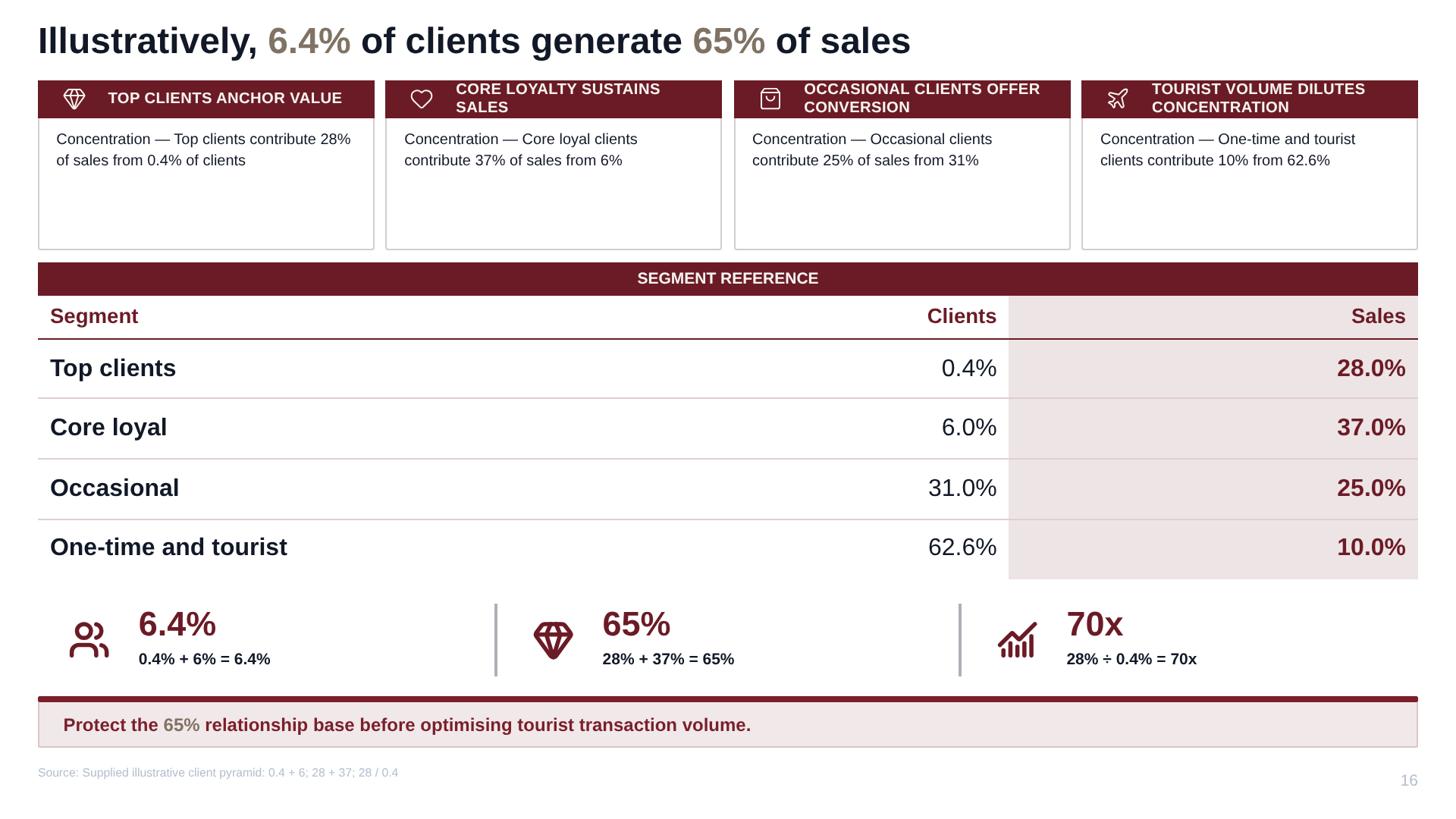
Common mistakes
| Mistake | Why it hurts | Fix |
|---|---|---|
| A topic title dressed up as a sentence ("This slide shows our churn") | It still says nothing | Say what the churn data shows |
| A claim the chart doesn't support | Loses trust on the first question | Do the Step 5 check every time |
| Three lines or more | The reader skims it, then skips it | Cut adjectives, move the so-what into a box, or split the slide |
| Vague quantities ("significantly", "strong growth") | Can't be checked, sounds like padding | Use the number |
| Hiding the bad news in the body | The Columbia problem | If the risk changes the decision, it goes in the title |
| Titles that don't connect across slides | No storyline. Every slide stands alone | Do the titles-only read (below) |
| Jargon or internal acronyms | Senior readers outside the team get lost | Write for the most senior person in the room |
The titles-only read
Once every slide has an action title, copy the titles into one document in order and read them as a paragraph. This tests the deck's horizontal logic, meaning whether the argument flows from slide to slide. (Vertical logic is the other test: does each slide's body support its own title?)
A strong titles-only read:
- States the situation and the problem in the first two or three titles.
- Gives the answer early, by the executive summary at the latest.
- Groups supporting titles by pillar, with each group making one argument.
- Has no two titles saying the same thing.
- Ends with a decision or next step.
If the titles don't read as a coherent memo, the deck isn't ready, however good the charts are. Fix this first, because it's the cheapest stage at which to fix it.
Where Whyston fits
Whyston writes the storyline before it builds slides, and every evidence slide gets an action title written from the numbers on that slide, each tagged with its source. The outline view is effectively a titles-only read, so you can fix the argument before you look at a single chart. It's a fast first draft, not a substitute for the Step 5 check.
Checklist
- Every argument slide has a full-sentence title with a verb
- Each title is two lines or fewer
- Each title contains the decisive number or comparison
- The chart proves exactly what the title claims, no more and no less
- Any risk that changes the decision is in a title, not in a footnote
- One idea per title
- The titles-only read flows as an argument and ends with a decision
- No jargon the most senior reader wouldn't use
- Every number in a title also appears, with its source, on the slide
FAQ
What is an action title on a slide?
An action title is a slide headline written as one complete sentence that states the slide's conclusion, for example "Churn, not acquisition, explains 70% of the revenue gap" instead of "Revenue analysis". The body of the slide then proves that sentence.
How long should an action title be?
Aim for one line and accept two. In practice that's roughly 8 to 18 words. If you need a third line, the slide is usually making two points and should be split.
Should every slide have an action title?
Every slide that makes an argument should. Cover slides, section dividers, agendas and pure appendix data tables can keep descriptive titles, although appendix slides still benefit from a sentence that tells the reader why the data matters.
Is there evidence that sentence headlines work better than topic titles?
Yes. In a controlled study published in the International Journal of Engineering Education (2013), Garner and Alley found that students shown slides with sentence headlines and visual evidence understood the material better and held fewer misconceptions than students shown topic titles with bullet lists.
What is the difference between an action title and a so-what?
The action title states what the evidence shows and what it means. A so-what, sometimes placed in a box at the bottom of the slide, states what the audience should do about it. Strong titles often contain both. When they don't fit in one sentence, the so-what goes in the box.
How do I check whether my action titles work as a storyline?
Copy every title into a single document in slide order and read them top to bottom. If the titles alone tell the full argument, with no gaps or repetitions, the deck has horizontal logic. If you can't follow the argument from titles alone, fix the titles before touching the charts.