
An executive summary slide states the answer to the audience's question, the two to four reasons that support it, and the decision you need, all on one page that a senior reader can absorb in about a minute. It's usually the most-read slide in the deck. Many board members and executives read it carefully and skim the rest, so it has to make the full case on its own.
This guide covers what belongs on the slide, a six-step method, an annotated before-and-after example, variants for boards, steering committees and investment committees, and a final checklist.
What an executive summary slide is (and isn't)
An executive summary slide is the whole argument of the deck compressed onto one page: the governing thought from your Pyramid Principle storyline as the title, the pillars as supporting statements, and the ask at the bottom.
| It is | It isn't |
|---|---|
| A set of conclusions | A list of topics (that's an agenda) |
| Written in full sentences | Fragment bullets ("Market growth", "Risks") |
| A standalone document | A teaser for the "real" content later |
| Specific: numbers, names, dates | General: "significant opportunity", "various options" |
| Ends with a decision or next step | Ends with "Questions?" |
The structure follows the same principle as journalism's inverted pyramid and the military's "bottom line up front": put the most important information first because readers stop early. Nielsen Norman Group recommends this for anything people skim. Kabir Sehgal's HBR piece on military-style email makes the same case for messages that need an action.
Anatomy: the five parts
| Part | Content | Length |
|---|---|---|
| 1. Title = the answer | The governing thought as an action title | 1–2 lines |
| 2. Context (optional) | Situation + complication in one or two sentences | 1–2 lines |
| 3. Supporting statements | 2–4 claims, one per pillar, each a full sentence in bold | 1 line each |
| 4. Evidence under each | The one number or fact that makes the claim believable, with its source | 1–2 lines each |
| 5. The ask | Decision, approval or next step, with owner and date | 1–2 lines, in a box |
Total: roughly 80–180 words. If you're well past that, the storyline is probably still unclear.
How to write it: six steps
Step 1: Write the audience's question at the top of a blank page
"Should we enter Germany in 2027?" "Why did Q3 miss, and what are we doing about it?" If you can't write the question, nothing below it will hold together.
Step 2: Answer it in one sentence, then make that sentence the title
Specific enough to be wrong. "Enter Germany in 2027 through a co-packing partner, not our own plant" is an answer. "Germany: market entry considerations" isn't.
Step 3: List the reasons and group them into 2–4 pillars
Ask "why?" of the answer. Group the reasons so they're MECE (see the issue tree guide). Each pillar becomes one bold supporting statement.
Step 4: Give each pillar its single best piece of evidence
Pick the one number that would persuade a sceptic, and say where it comes from. Keep the rest of the proof for the body of the deck.
Step 5: Write the ask
Say what you need, from whom and by when. If there's no decision, state the next step and its date.
Step 6: Edit as a reader, then cut
Read it as if you were the most senior, busiest person in the room. Strike adjectives, replace vague quantities with numbers, and swap jargon for plain words (the U.S. federal plain-language guidelines and GOV.UK's writing guidance are both good references). Amazon's 2017 shareholder letter describes how much rewriting a good narrative memo takes: "Great memos are written and re-written" (Jeff Bezos). The same is true of the one slide everyone reads.
Annotated example: before and after
The company and figures below are illustrative, built to demonstrate the method. A mid-sized UK snack manufacturer is deciding whether to enter Germany.
Before
Title: Executive Summary
- Market overview
- The German snack market is large and growing
- Competitive landscape analysed
- Several entry options considered
- Risks and mitigations
- Next steps
What's wrong: the title is a label. Four of the six bullets are topics, not claims. "Large and growing" has no number. The options are mentioned but none is recommended. There's no decision. A board member reading this learns only that work was done.
After
The annotations:
| Marker | What it does | Why |
|---|---|---|
| A1 Title is the answer | Recommendation plus the two reasons that matter most (speed, capital) | A reader who stops here still knows what you recommend and why |
| A2 One line of context | Situation (UK growth slowing) and complication (an open gap in Germany) | Enough framing to make the answer relevant. No history lesson |
| A3 Pillar 1: demand | A claim in bold, one number underneath | Answers "Is there a market?" |
| A4 Pillar 2: entry mode | Compares the recommended option with the obvious alternative | Answers "Why this way?" and anticipates the board's challenge |
| A5 Pillar 3: feasibility | Evidence that the plan can actually start | Answers "Can we do it?" The three pillars are MECE: market, mode, execution |
| A6 The ask | Amount, scope, a gate, an owner | Turns a presentation into a decision |
| A7 Sources | Every number traceable | The first question a board asks is "Where's that from?" |
Read the bold lines alone: demand exists → co-packing beats a plant → retailers are ready. That's the deck's storyline in three sentences, and the sections behind the summary should follow it in the same order, each with action titles that expand one pillar.
Variants by audience
| Audience | Their question | Lead with | Typical ask |
|---|---|---|---|
| Board | Should we approve this, and what's the risk? | Recommendation + capital at risk | Approval, with gates |
| Steering committee | Are we on track, and what do you need from us? | Status against plan in one line | Unblock a decision or resource |
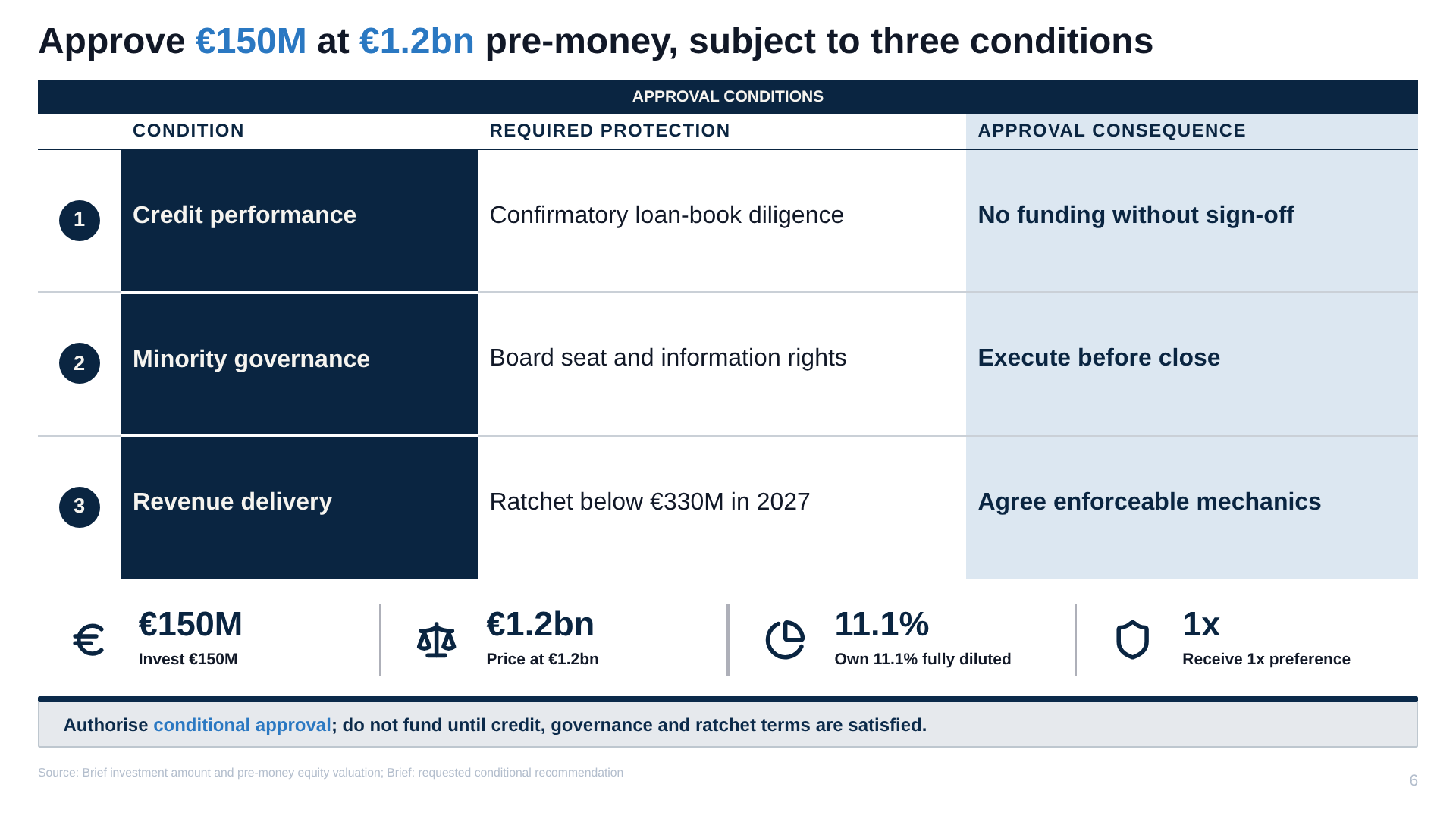
| Investment committee | Is this a good investment at this price? | Thesis + returns + key risk | Approve to next stage / final bid |
| Client CEO (consulting) | What should I do? | The recommendation | Mandate for the next phase |
| Project status update | What changed since last time? | The one change that matters | Decision on an issue or nothing (information only) |
A status-update summary often fails the same way the "before" example does: it lists activity ("completed 14 interviews") instead of findings ("interviews confirm price, not features, drives churn").
Test it on a cold reader
Before the meeting, give the slide to someone who hasn't seen the work, such as a colleague from another team, and give them 60 seconds. Then ask three questions:
- What are we recommending?
- Why should the audience believe it?
- What do we need from them, and by when?
If they can answer all three in their own words, the slide works. If they hesitate on the first question, the title isn't doing its job. If they hesitate on the second, a pillar is missing its evidence or two pillars overlap. If they hesitate on the third, the ask is buried or vague. This takes five minutes and catches most of what a senior reviewer would redline. It's also the best defence against the most common failure of all, which is a summary written for the team that did the work rather than for the person who has to decide.
Common mistakes
| Mistake | Why it hurts | Fix |
|---|---|---|
| "Executive Summary" as the title | Wastes the most-read line in the deck | Put the answer in the title |
| Topics instead of findings | The reader learns nothing | Make every line a full-sentence claim |
| Too many points | Nothing stands out | Two to four pillars. Move the rest to the body |
| No numbers | Sounds like opinion | One number per pillar, with its source |
| Hedging everything | Reads as no recommendation | Commit, then state the key risk once |
| No ask | The meeting ends without a decision | Decision box with owner and date |
| Summary and body disagree | Credibility loss on the first question | Rewrite the summary last, against the final titles |
| Written once, early | Reflects the hypothesis, not the evidence | Draft first, rewrite last |
Checklist
- The title answers the audience's question in one sentence
- Context is at most two lines
- 2–4 supporting statements, MECE, each a full sentence in bold
- Each statement has one piece of evidence with a source
- Every number matches the slide where it's proven
- The decision or next step names an owner and a date
- About 80–180 words in total, readable in a minute
- The bold lines alone tell the storyline
- The section order behind the summary matches the order of its pillars
Where Whyston fits
Whyston drafts the executive summary from the same storyline it uses to build the deck. The title is the governing thought, each supporting line maps to a pillar, and the numbers carry their sources through from your documents. The draft is consistent with the slides behind it by construction. The judgement calls are still yours: what to recommend, what to leave out, and what to ask for.
FAQ
What should an executive summary slide include?
The answer to the audience's question as the slide title, two to four supporting statements that each carry one piece of evidence, and the decision or next step you need. Optionally, one or two lines of situation and complication before the supporting statements.
How long should an executive summary slide be?
One slide, readable in about a minute. As a rule of thumb, that's 80 to 180 words. If it needs more, the storyline isn't yet clear enough, or the content belongs in a written memo.
Should the executive summary come first or last in the deck?
First, straight after the title slide. Senior readers often read only the executive summary, so it has to stand alone. A closing slide can restate the decision, but it doesn't replace the summary up front.
Is an executive summary the same as an agenda?
No. An agenda lists the topics you'll cover. An executive summary states what you concluded. A slide that says "We will discuss market, competition and options" is an agenda, whatever its title.
Can I use bullets on an executive summary slide?
Yes, if each bullet is a full sentence that makes a claim and the bullets form a logical group. Avoid fragment bullets like "Market growth" that force the reader to guess what you concluded.
When should I write the executive summary?
Draft it first, as a hypothesis, to steer the analysis. Rewrite it last, when the evidence is in. The final version should match the action titles of the slides behind it.