Sterling Pay: Conditional Investment Approval
A 31-slide investment committee paper recommending a conditional €150M Series D investment in a European SME payments company.
- Prepared for
- Fund investment committee
- Length
- 31 slides
- Made with
- Whyston, exported to PowerPoint
The brief, and what to look at
The brief
A growth fund’s investment committee needed a recommendation on a €150M Series D at €1.2bn pre-money, using Eurostat and ECB data and the company’s plan.
What to look at
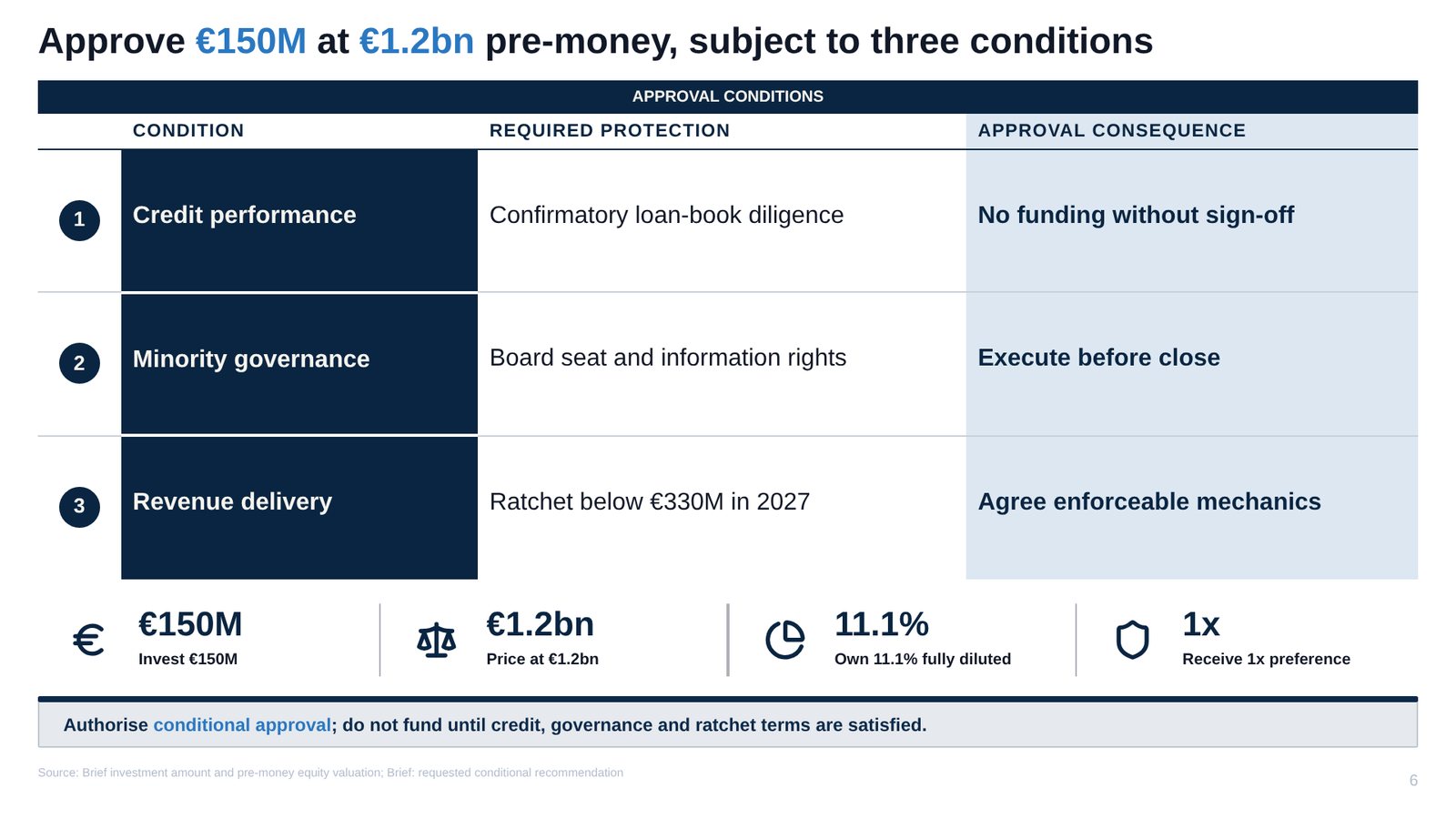
- The recommendation and its three conditions sit on slide 6, before the evidence.
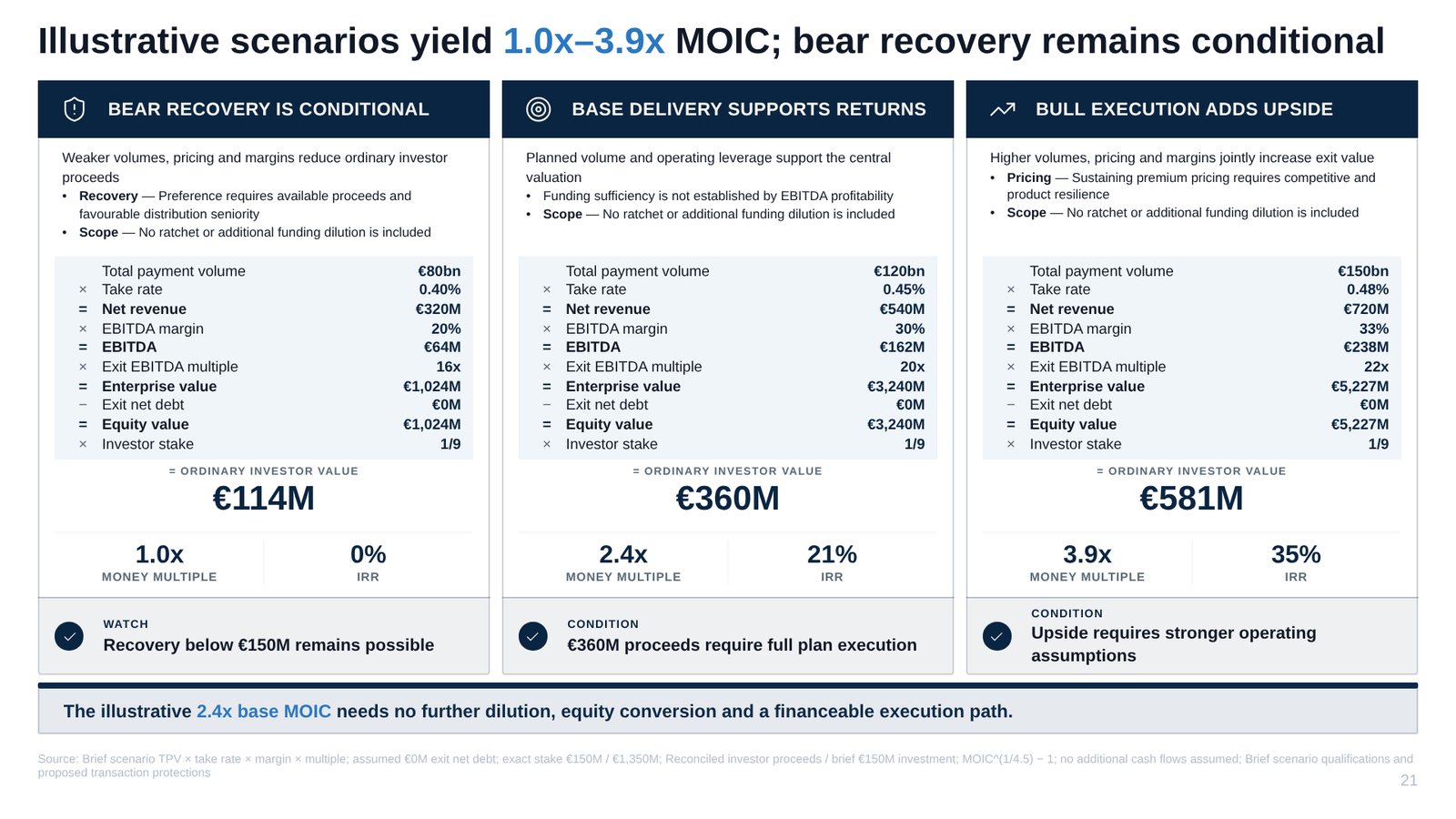
- Valuation attribution, scenarios (1.0x–3.9x MOIC) and sensitivities make the returns case testable.
- Uploaded market data is kept apart from unverified claims in the brief.
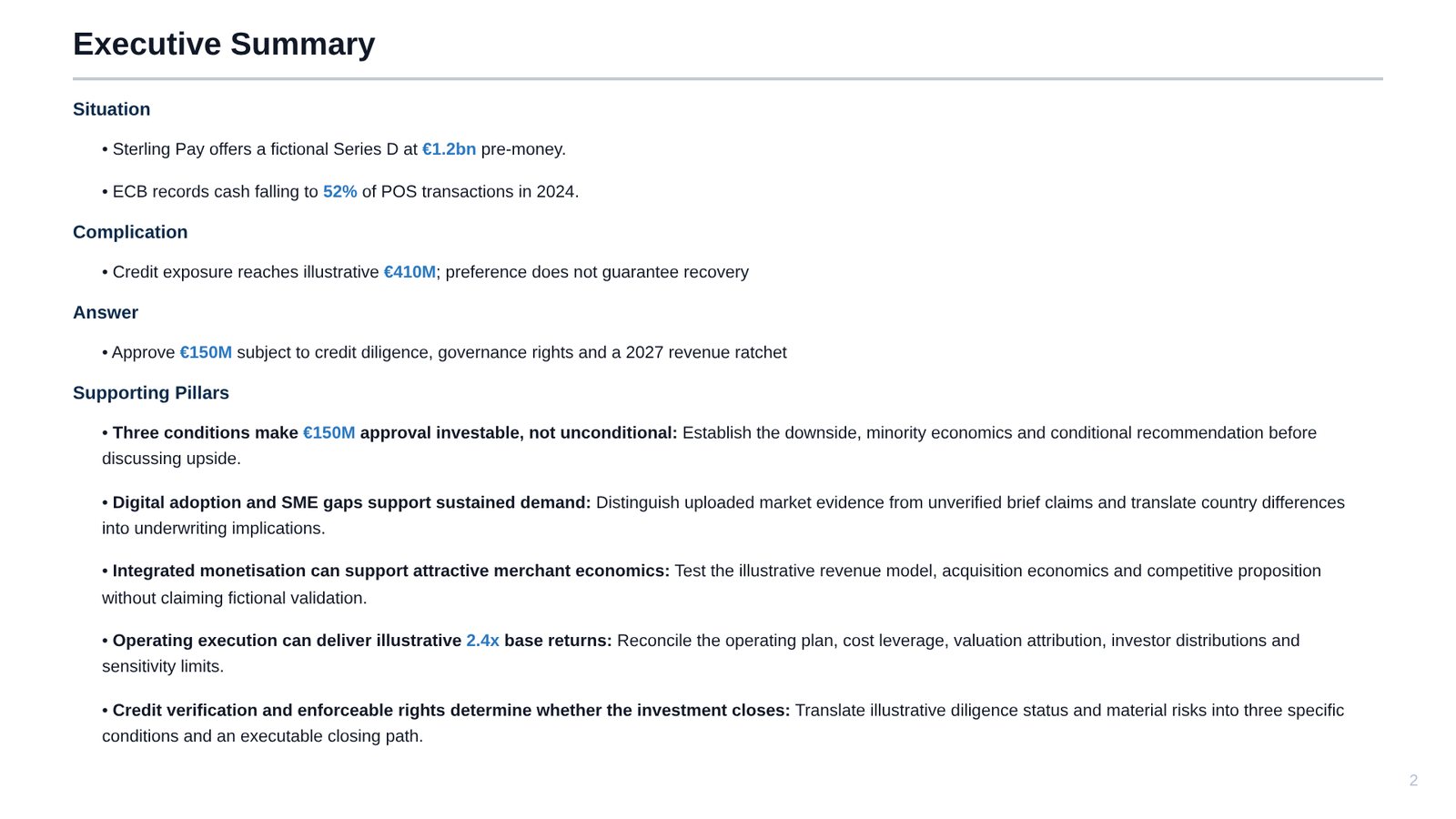
The executive summary
Written in SCQA order: the situation, what complicates it, the answer, then the pillars the rest of the deck proves.
- Situation
Sterling Pay offers a fictional Series D at €1.2bn pre-money.
ECB records cash falling to 52% of POS transactions in 2024.
- Complication
Credit exposure reaches illustrative €410M; preference does not guarantee recovery
- Answer
Approve €150M subject to credit diligence, governance rights and a 2027 revenue ratchet
- Supporting pillars
- Three conditions make €150M approval investable, not unconditional
- Digital adoption and SME gaps support sustained demand
- Integrated monetisation can support attractive merchant economics
- Operating execution can deliver illustrative 2.4x base returns
- Credit verification and enforceable rights determine whether the investment closes
The storyline, title by title
Every slide title in the deck, in order. Each one is a full-sentence claim, so the titles alone tell the story.
Conditional Entry
Start with what the fund can lose and what its minority rights actually provide. The proposed investment is approved only through a controlled closing path.
- The 1x preference supports bear recovery, but does not guarantee capital protection
- Approve €150M at €1.2bn pre-money, subject to three conditions
Structural Demand
Uploaded evidence supports digital adoption and SME capability gaps. It does not independently validate every market assertion in the brief or Sterling’s ability to capture the opportunity.
- Uploaded Eurostat data supports rising adoption; card-volume tripling remains unverified
- Cash falls 7 pp while cards gain 5 pp at the point of sale
- Small-firm e-commerce adoption trails large firms by 27.1 pp
- Germany and France generate illustrative 53% of revenue across differing digital markets
- Adyen Platforms grows 37% versus approximately 19% for the group
Commercial Economics
The illustrative revenue and acquisition model is plausible, but credit-adjusted economics and competitive differentiation need verification.
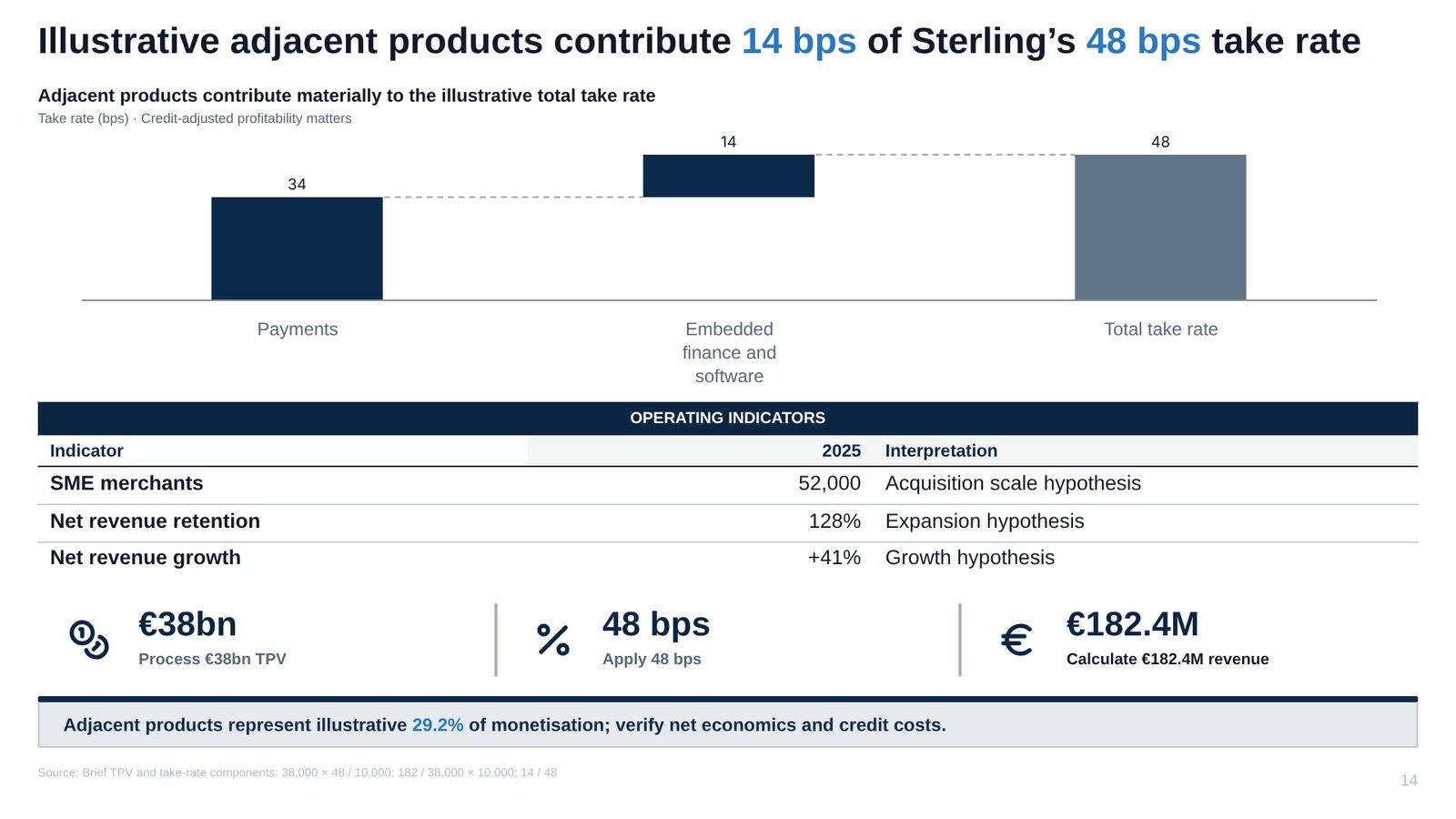
- Illustrative adjacent products contribute 14 bps of Sterling’s 48 bps take rate
- Illustrative contribution supports 14.4-month payback; lifetime-value assumptions need reconciliation
- Sterling’s SME proposition is plausible, but competitive superiority remains unproven
Plan and Returns
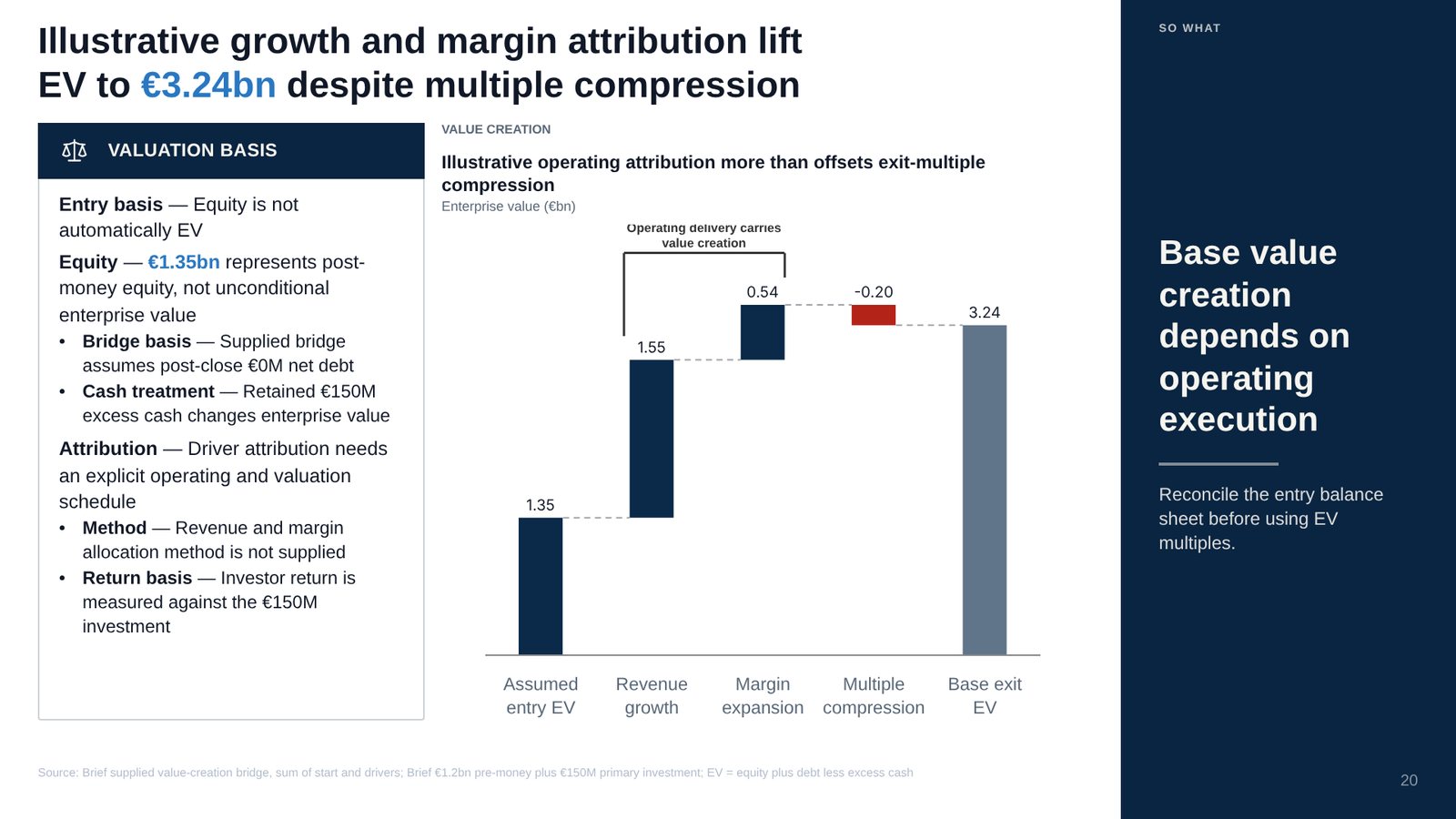
Operating delivery, rather than multiple expansion, drives the central case. Cash sufficiency, EV conversion and sensitivity reconciliation remain essential underwriting qualifications.
- Illustrative revenue requires 24.3% annual growth; the 2027 hurdle demands faster early execution
- Illustrative costs grow slower than revenue, but €150M funding sufficiency remains unproven
- Illustrative growth and margin attribution lift EV to €3.24bn despite multiple compression
- Illustrative scenarios yield 1.0x–3.9x MOIC; bear recovery remains conditional
- Volume and exit pricing dominate supplied sensitivities; the TPV row needs reconciliation
Closing Controls
Credit remains the explicit unfinished diligence gate. Governance and a negotiated revenue ratchet must convert approval conditions into enforceable protection.
- Illustrative diligence leaves credit amber; bank ratios cannot validate Sterling’s loss rate
- Structural benefits support approval only with credit, pricing and competition controls
- Release €150M only after credit sign-off, governance rights and the revenue ratchet
- Approve €150M conditionally; fund only after the three protections are enforceable
The company at the centre of this deck is fictional, and figures marked illustrative in the deck are made up for the example. Public figures come from the sources listed on the deck’s Figures & Assumptions pages, which Whyston adds to every deck.