
Member State K: Semiconductor Strategy
A 33-slide board deck setting a national €3bn semiconductor investment portfolio for a public investment agency.
- Prepared for
- Board of the national investment agency
- Length
- 33 slides
- Made with
- Whyston, exported to PowerPoint
The brief, and what to look at
The brief
A national investment agency’s board asked where a €3bn mandate should go in semiconductors, using EU, US and trade data, and what to approve first.
What to look at
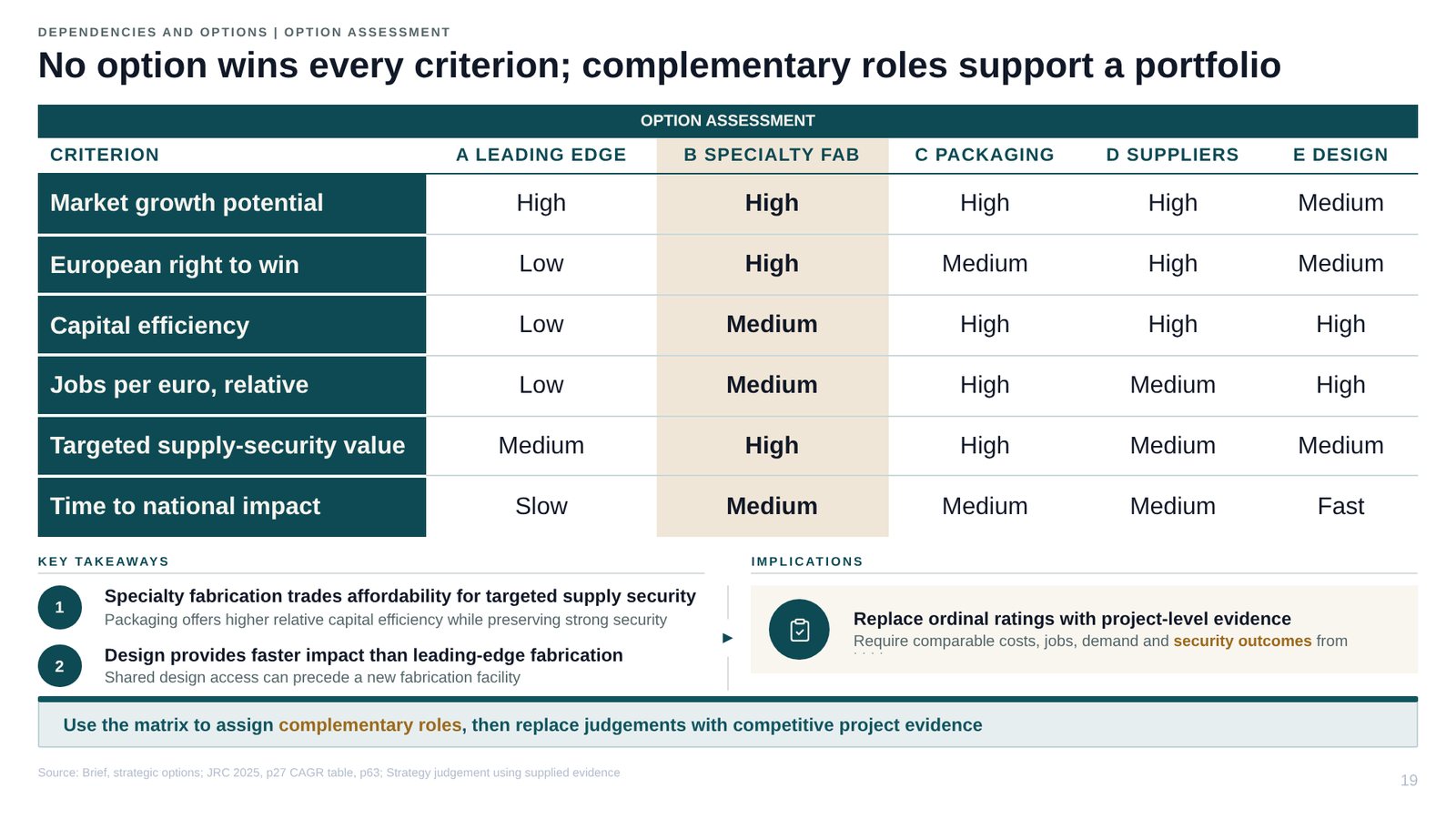
- An option matrix compares leading-edge, specialty, packaging, suppliers and design on the same criteria.
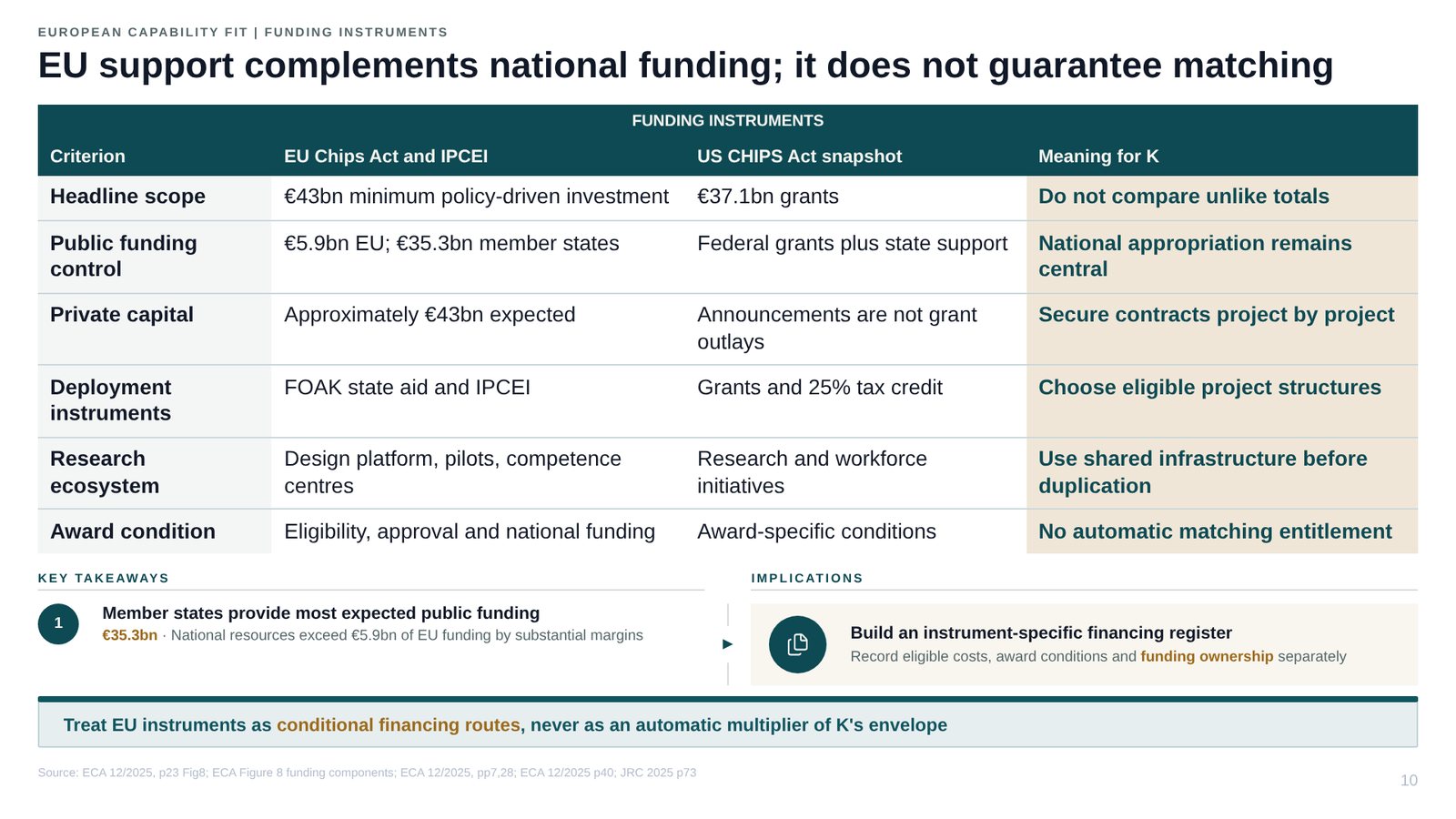
- EU Chips Act and US CHIPS Act figures are compared without treating them as like for like.
- The board resolutions are written out, with gates before any project commitment.
The executive summary
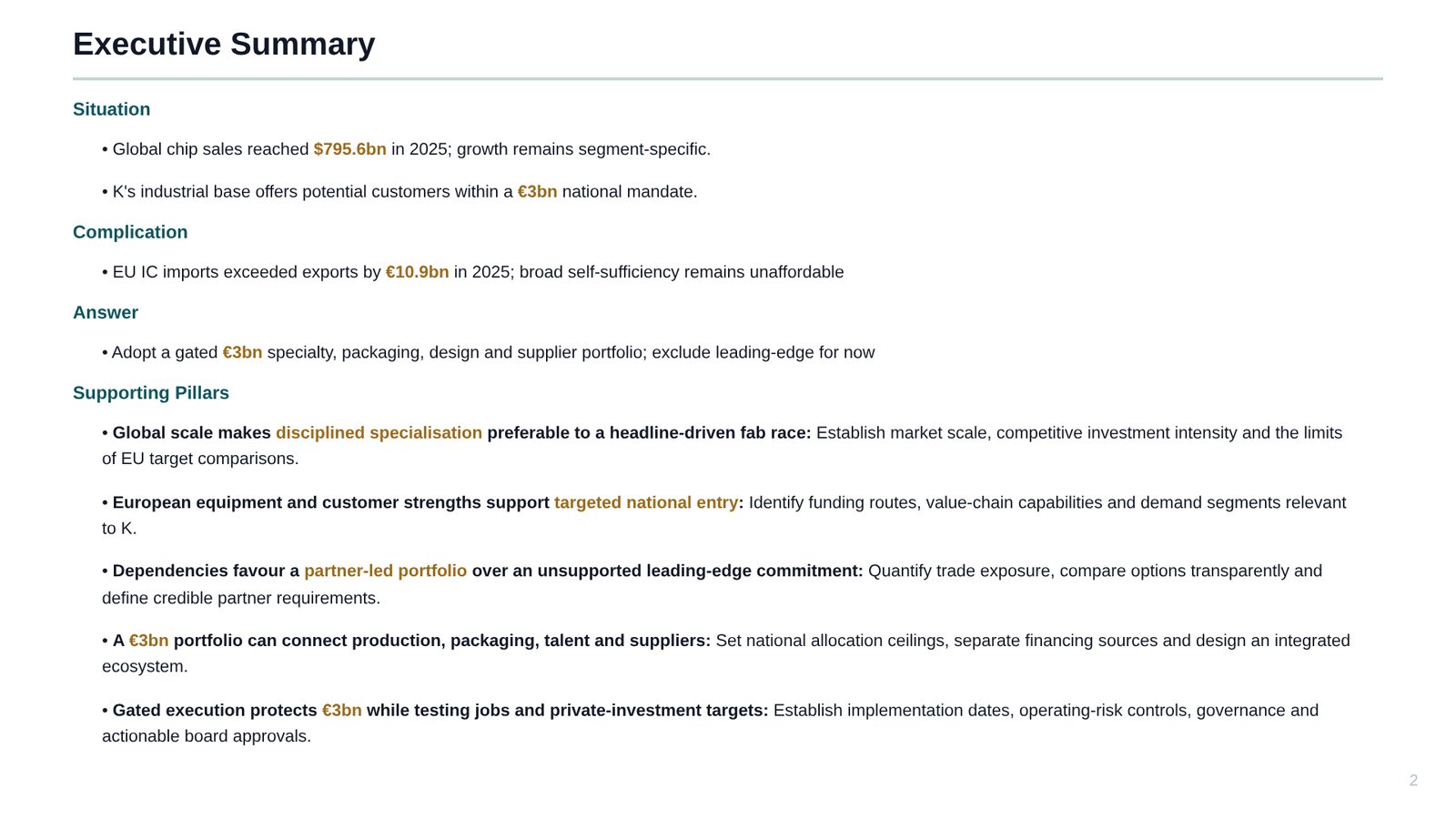
Written in SCQA order: the situation, what complicates it, the answer, then the pillars the rest of the deck proves.
- Situation
Global chip sales reached $795.6bn in 2025; growth remains segment-specific.
K's industrial base offers potential customers within a €3bn national mandate.
- Complication
EU IC imports exceeded exports by €10.9bn in 2025; broad self-sufficiency remains unaffordable
- Answer
Adopt a gated €3bn specialty, packaging, design and supplier portfolio; exclude leading-edge for now
- Supporting pillars
- Global scale makes disciplined specialisation preferable to a headline-driven fab race
- European equipment and customer strengths support targeted national entry
- Dependencies favour a partner-led portfolio over an unsupported leading-edge commitment
- A €3bn portfolio can connect production, packaging, talent and suppliers
- Gated execution protects €3bn while testing jobs and private-investment targets
The storyline, title by title
Every slide title in the deck, in order. Each one is a full-sentence claim, so the titles alone tell the story.
Global Investment Discipline
A growing global market does not make every segment equally accessible. K needs an ambition grounded in customers, capabilities and financeable projects.
- Choose specialisation, not an unfinanced leading-edge ambition
- Global sales reached $795.6bn; $1.5tn is forecast
- US investment announcements reach $770bn across the ecosystem
- EU's 11.7% revenue forecast does not establish 20% production
European Capability Fit
Europe's strongest positions are selective, not universal. Funding instruments can support national entry, but neither regional leadership nor EU matching should be assumed.
- EU support complements national funding; it does not guarantee matching
- European strengths span equipment, specialty products and industrial customers
- Europe's 66% specialist mix favours automotive and industrial entry
- Automotive demand is forecast to reach €17.4bn
- Equipment strengths coexist with only 1.4% in testing
Dependencies and Options
Trade exposure identifies security needs, not an obligation to manufacture every imported chip. Compare the options consistently and select partners who bring technology, customers and binding capital.
- EU integrated-circuit trade retains a €10.9bn deficit
- Taiwan and Malaysia supply 41.1% of IC imports
- Leading-edge combines high capital burden with a weaker European starting position
- No option wins every criterion; complementary roles support a portfolio
- Specialty partners must bring technology, customers and capital
Portfolio and Ecosystem
National allocations are ceilings, while private investment and employment remain targets to validate. Shared infrastructure must connect the portfolio to qualified demand rather than become an isolated asset.
- Allocate 70% to specialty fabrication and back-end capabilities
- The €7bn private target is not committed financing
- An integrated ecosystem must turn talent and customer demand into qualified products
Delivery and Decisions
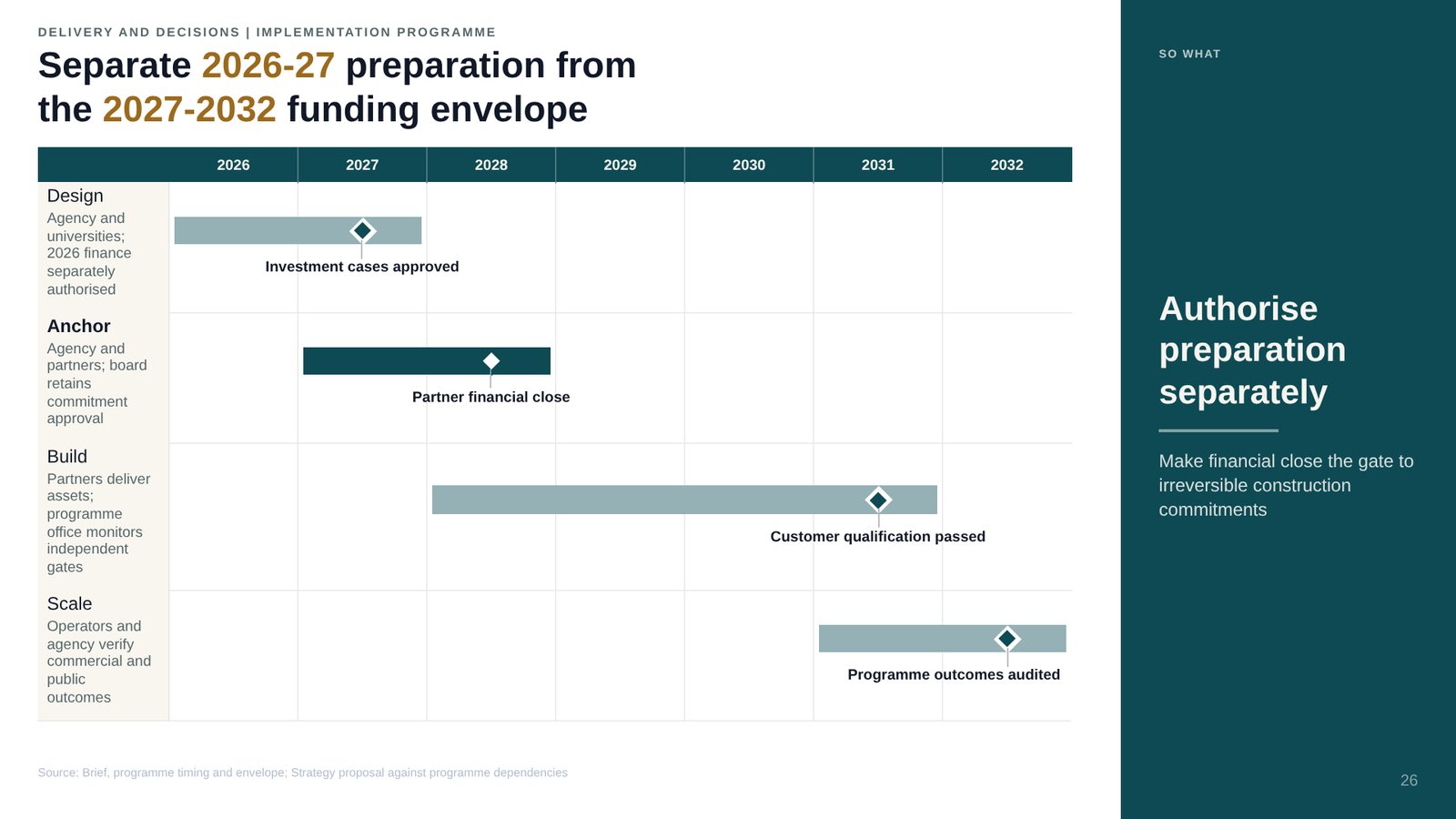
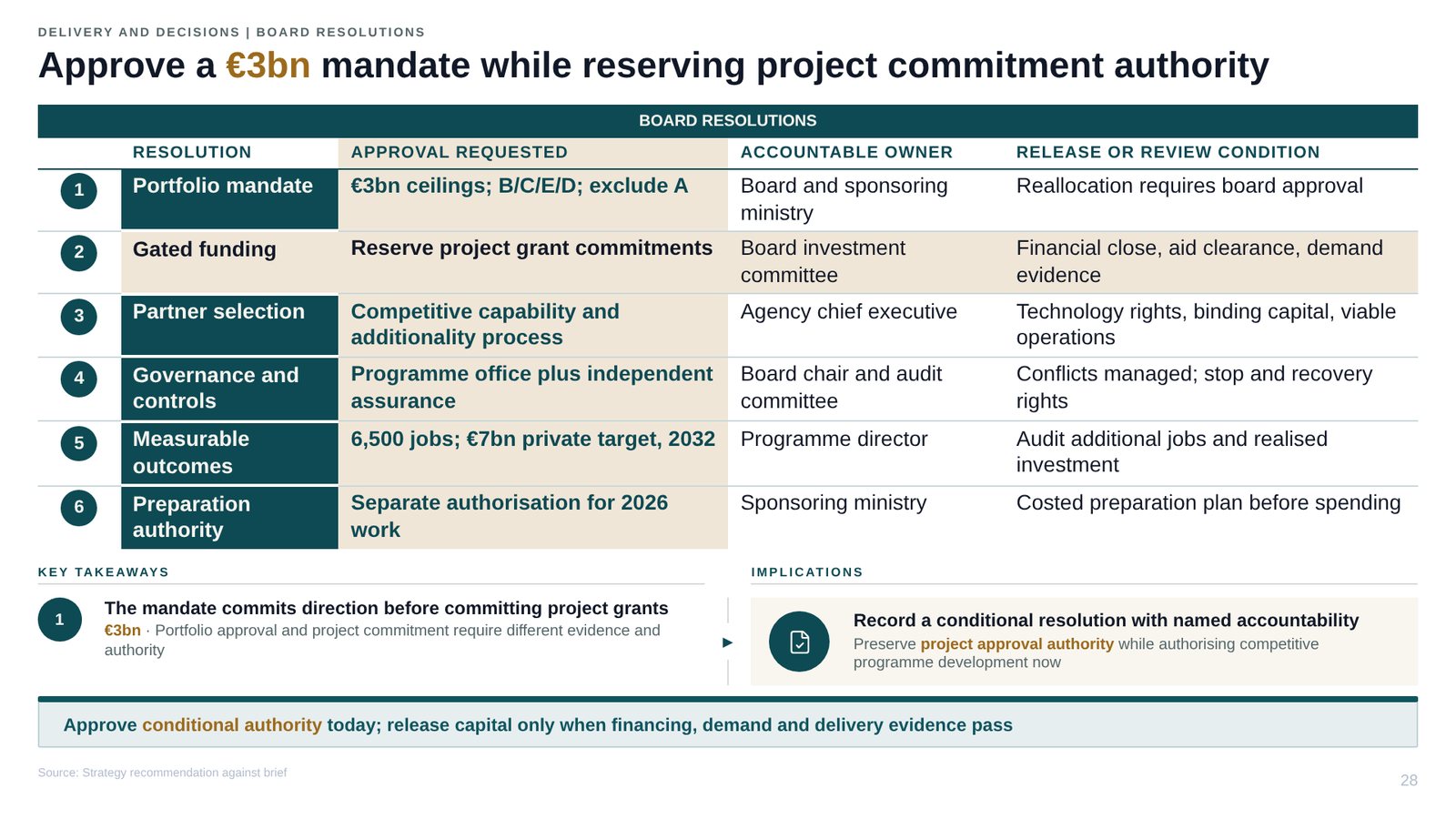
Separate preparation from programme funding and commitments from outcomes. The board should approve conditional authority, enforceable controls and auditable milestones.
- Separate 2026-27 preparation from the 2027-2032 funding envelope
- Protect €3bn through enforceable funding and operating-risk controls
- Approve a €3bn mandate while reserving project commitment authority
- Authorise a gated €3bn portfolio and reserve project commitments for validated investment cases
The company at the centre of this deck is fictional, and figures marked illustrative in the deck are made up for the example. Public figures come from the sources listed on the deck’s Figures & Assumptions pages, which Whyston adds to every deck.
More examples
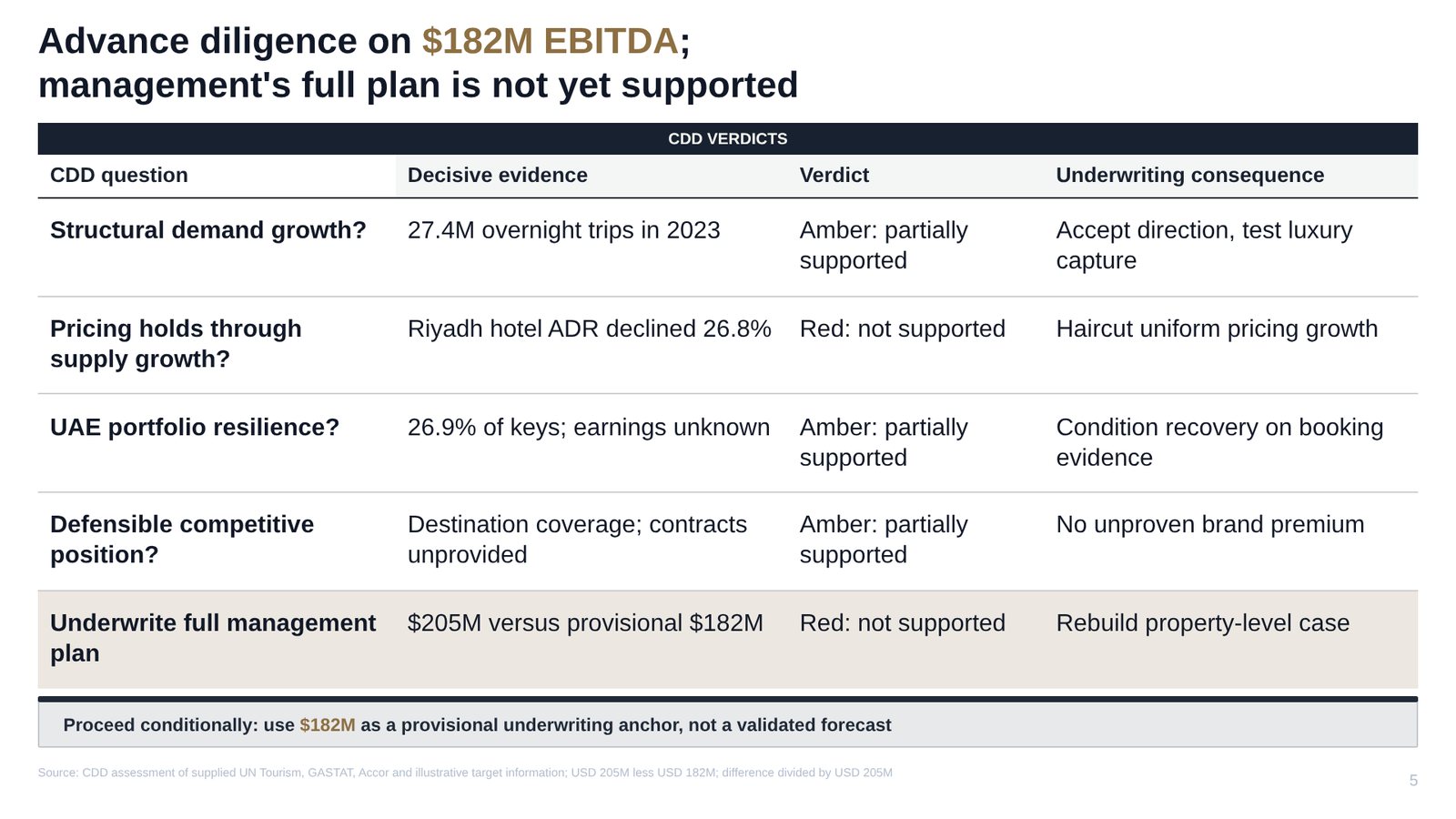 Project Meridian Commercial Due Diligence30 slides · Investment committee of a global private-equity fund
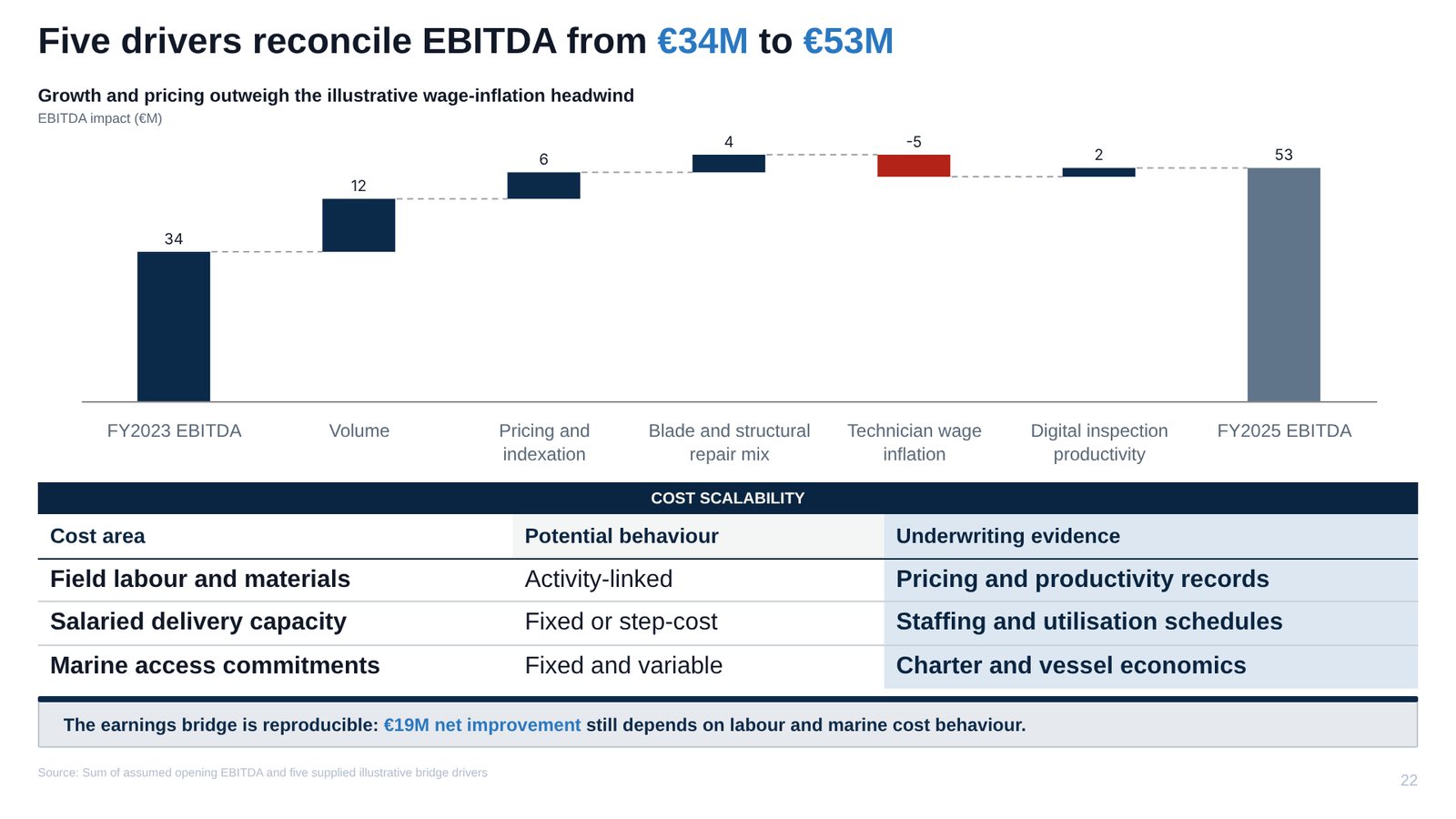 Project Aurora — Confidential Information Memorandum32 slides · Infrastructure funds, energy-transition private-equity funds and strategic buyers
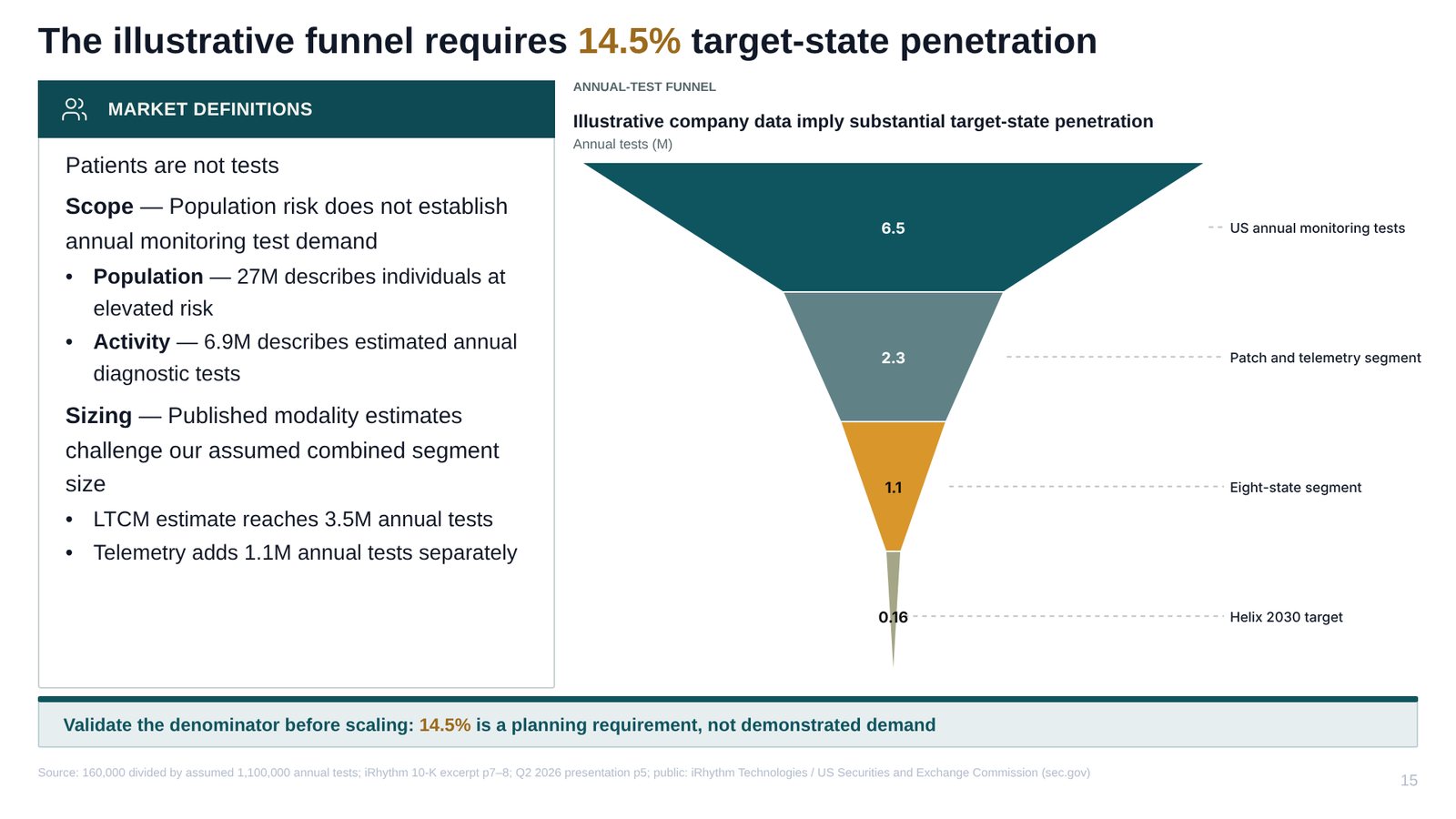 Helix Cardio US Entry Decision32 slides · Helix Cardio Board