Helix Cardio US Entry Decision
A 32-slide board deck on whether a European medtech company should enter the US cardiac-monitoring market, and how.
- Prepared for
- Helix Cardio Board
- Length
- 32 slides
- Made with
- Whyston, exported to PowerPoint
The brief, and what to look at
The brief
The board of a European cardiac-monitoring company asked how to reach $50M of US revenue: build, partner or acquire, and what to approve now.
What to look at
- Reimbursement codes and incumbent economics turn a broad market into the revenue Helix can actually capture.
- Three entry modes are compared on commitment, revenue and risk before one is recommended.
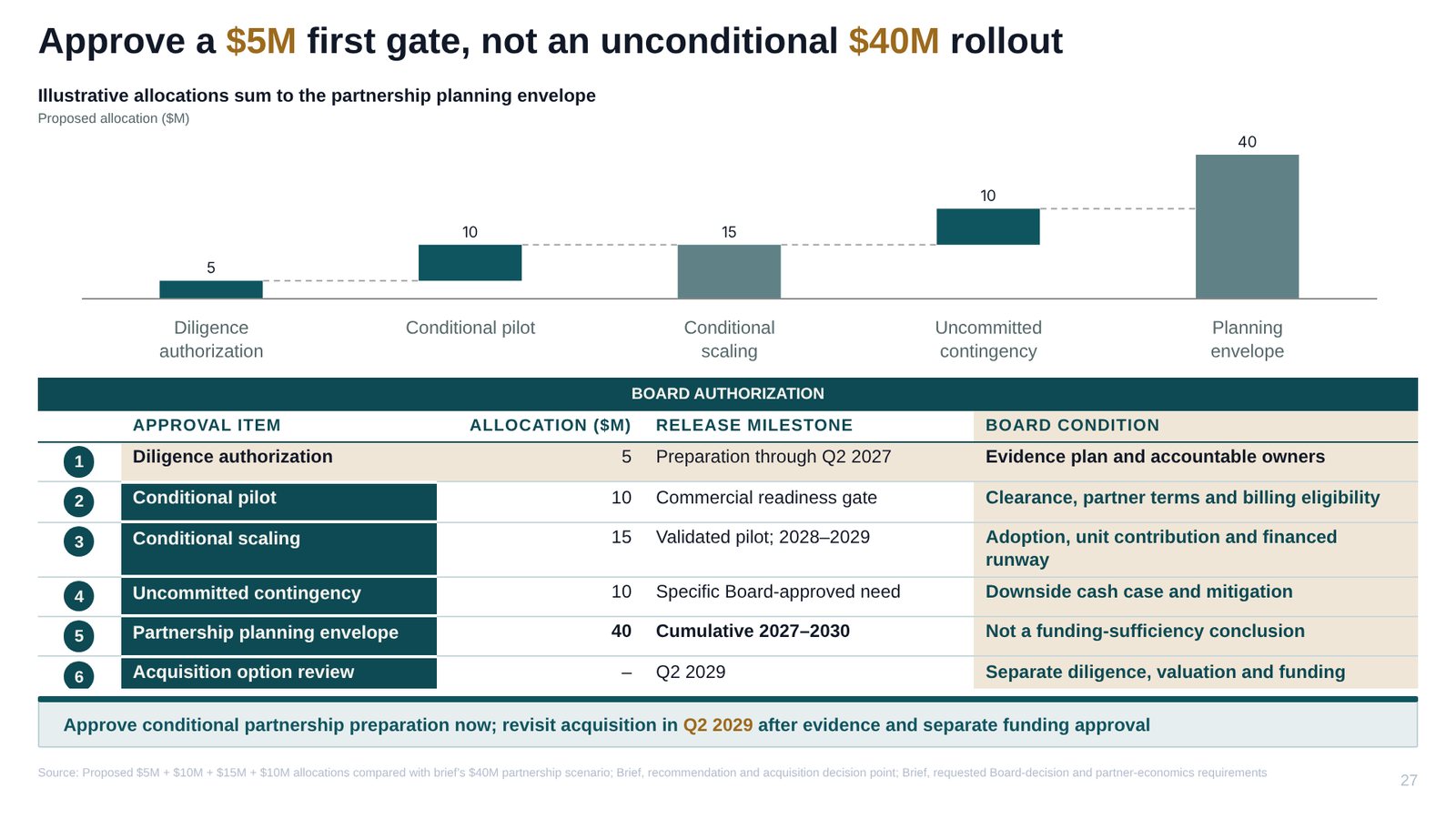
- The ask is a $5M first gate rather than the full $40M, with the milestones that release the rest.
The executive summary
Written in SCQA order: the situation, what complicates it, the answer, then the pillars the rest of the deck proves.
- Situation
US heart disease caused 683,491 deaths in 2024; broad burden is not patch eligibility.
US residents aged 65+ rise from 63.3M to 71.2M between 2025 and 2030.
- Complication
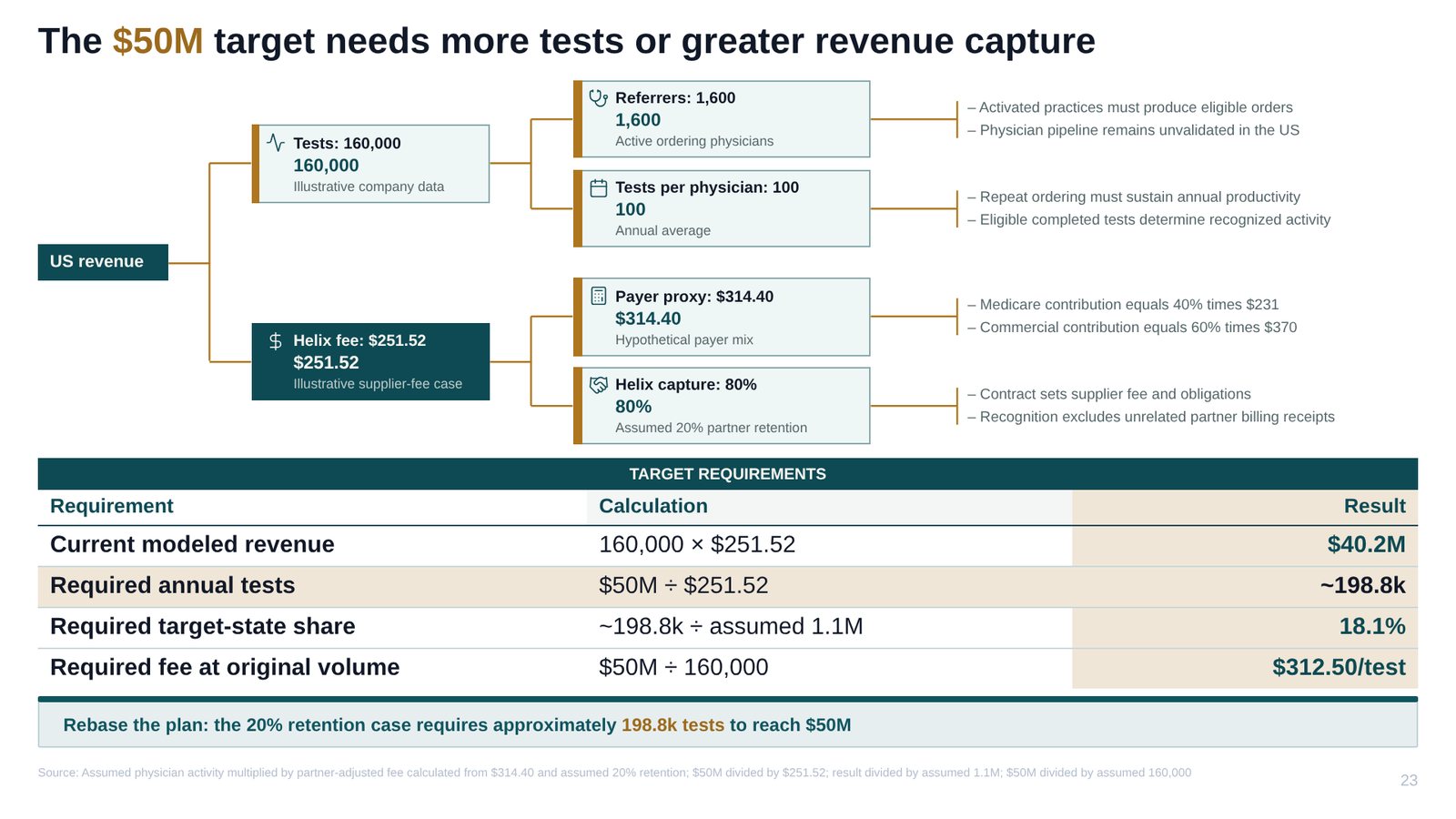
Partner retention of 20% reduces the illustrative 2030 case to $40.2M recognized revenue
- Answer
Approve gated partnership entry; retain the $50M ambition, but rebase volume and revenue capture
- Supporting pillars
- Ageing and monitoring adoption support a 2027 entry experiment
- Coding and incumbent economics constrain the value Helix can capture
- Helix can test a focused offer before committing to 8 states
- An IDTF partnership lowers commitment but does not yet support $50M recognized revenue
- Staged approvals preserve the Q2 2029 acquisition option
The storyline, title by title
Every slide title in the deck, in order. Each one is a full-sentence claim, so the titles alone tell the story.
Demand and Access
Clinical burden and demographic momentum justify investigation. They do not independently establish reimbursable demand or a revenue forecast.
- US unmet need warrants investigation, not a $50M commitment
- Ageing adds 7.9M older residents by 2030
- Medicare spending expands faster than other major payer pools
Market and Economics
The attractive monitoring category already has a scaled incumbent. Service components, payer contracts and operating capability determine who captures value.
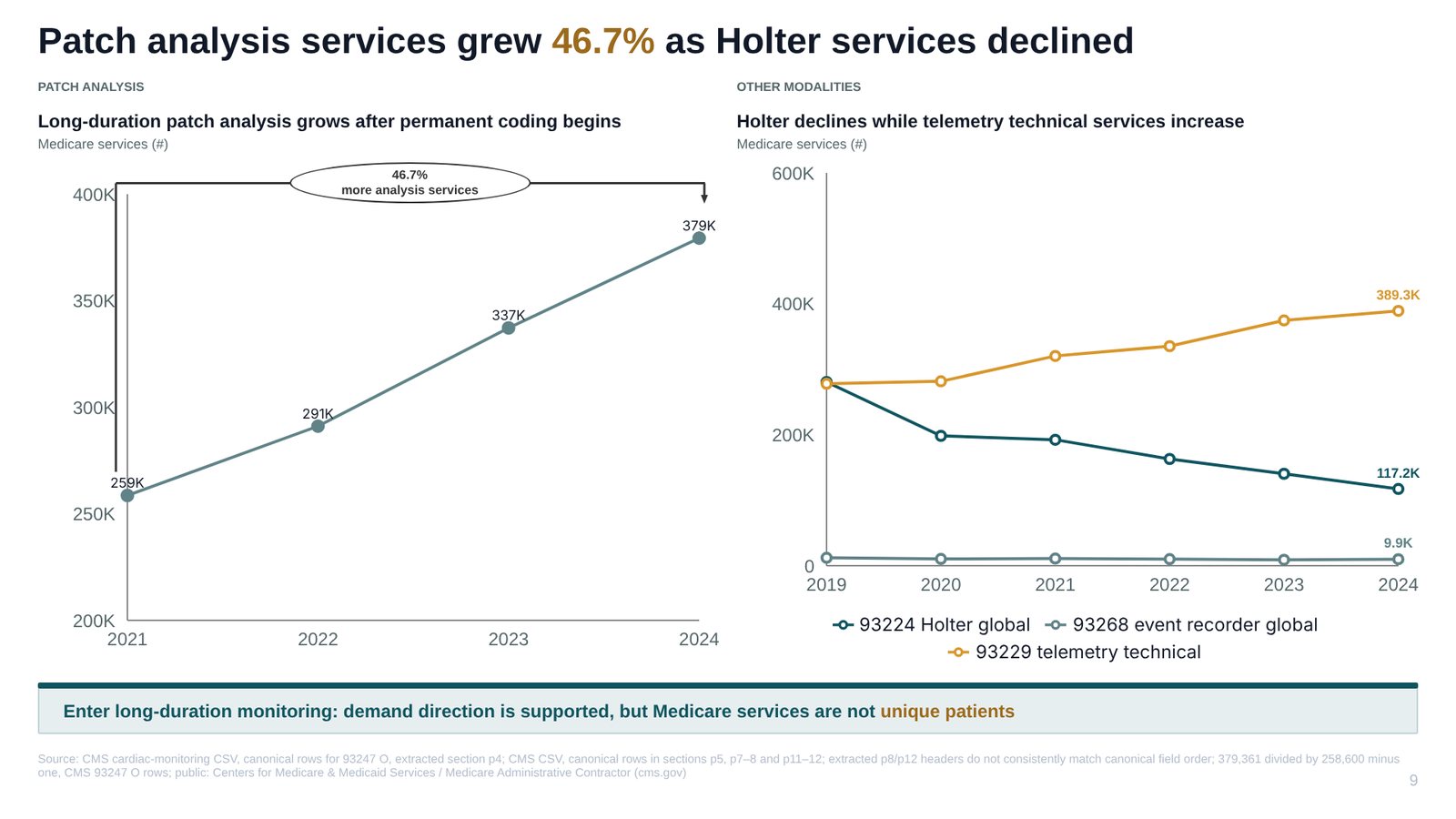
- Patch analysis services grew 46.7% as Holter services declined
- Medicare paid $231 for patch analysis, not the entire test
- Contractual service responsibility determines who earns patch revenue
- iRhythm’s 40% penetration is not its modality market share
- iRhythm’s 70.6% gross margin coexists with a $44.6M net loss
Beachhead and Advantage
European experience provides a starting point, not US superiority. The beachhead and differentiated workflow must earn their place through evidence.
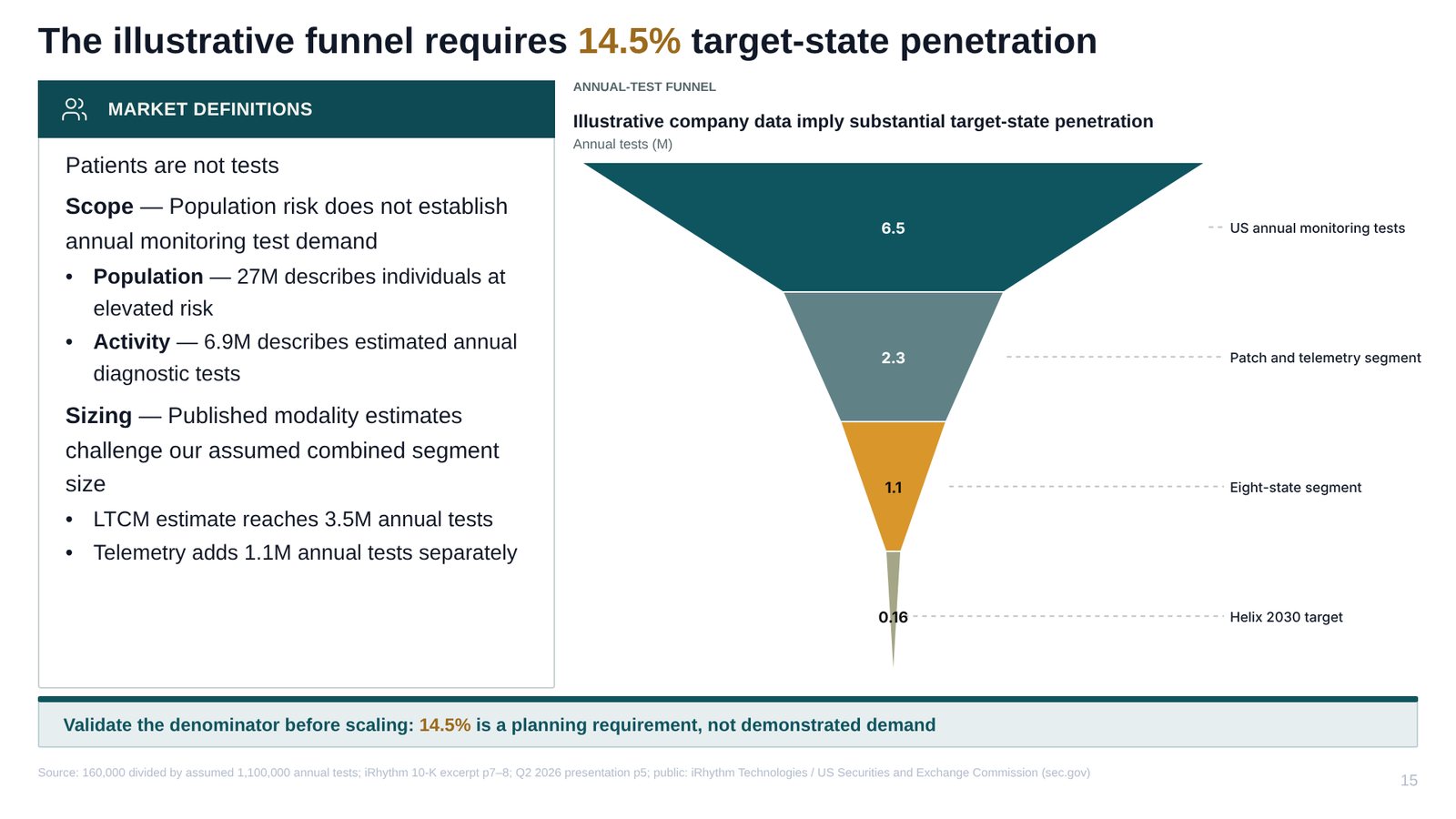
- The illustrative funnel requires 14.5% target-state penetration
- The 8-state beachhead remains a selection hypothesis
- European credentials justify a US test, not presumed superiority
- Turnaround and cost advantages must be earned in the pilot
Entry and Revenue
Partnership preserves flexibility, but the original revenue case conflates payer realization with Helix revenue. Contract economics and activity requirements must be rebuilt together.
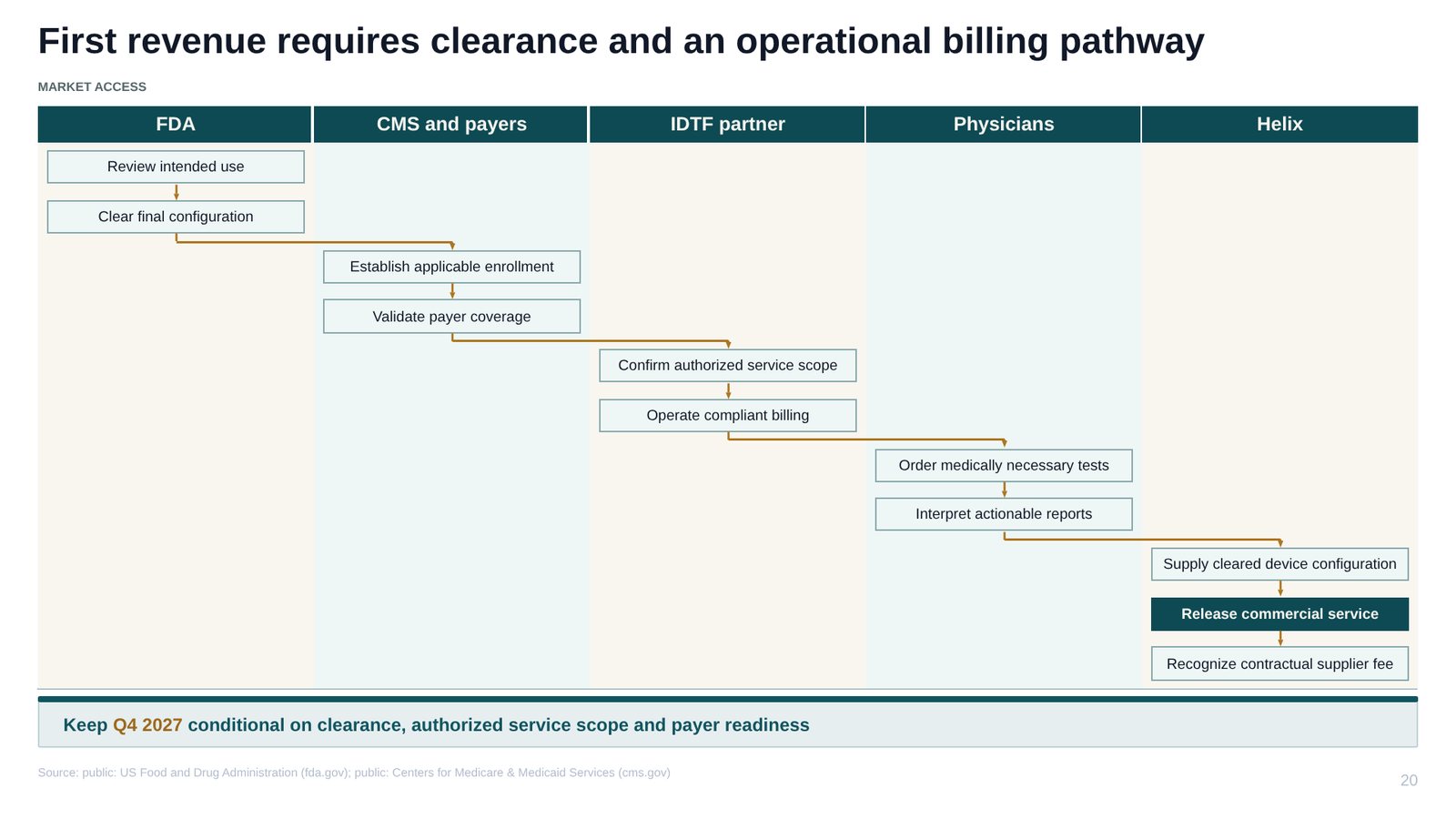
- First revenue requires clearance and an operational billing pathway
- Partnership offers the lowest illustrative commitment at $40M
- Partner-adjusted revenue falls below the $50.4M billing scenario
- The $50M target needs more tests or greater revenue capture
Execution and Approvals
Conditional launch gates protect clinical credibility and capital. Acquisition remains a later choice supported by operating evidence and separate funding.
- Q4 2027 first tests remain conditional, not scheduled certainty
- Clearance failure and weak adoption threaten the 2030 case
- Approve a $5M first gate, not an unconditional $40M rollout
- Authorize $5M to validate partnership entry before committing to scale
The company at the centre of this deck is fictional, and figures marked illustrative in the deck are made up for the example. Public figures come from the sources listed on the deck’s Figures & Assumptions pages, which Whyston adds to every deck.