Project Meridian Commercial Due Diligence
A 30-slide commercial due diligence for a private-equity investment committee weighing a 60% stake in a Saudi and UAE hotel platform.
- Prepared for
- Investment committee of a global private-equity fund
- Length
- 30 slides
- Made with
- Whyston, exported to PowerPoint
The brief, and what to look at
The brief
An investment committee asked whether management’s $205M EBITDA plan for a 14-hotel, 3,900-key platform holds up, using official tourism and hotel statistics plus the target’s own figures.
What to look at
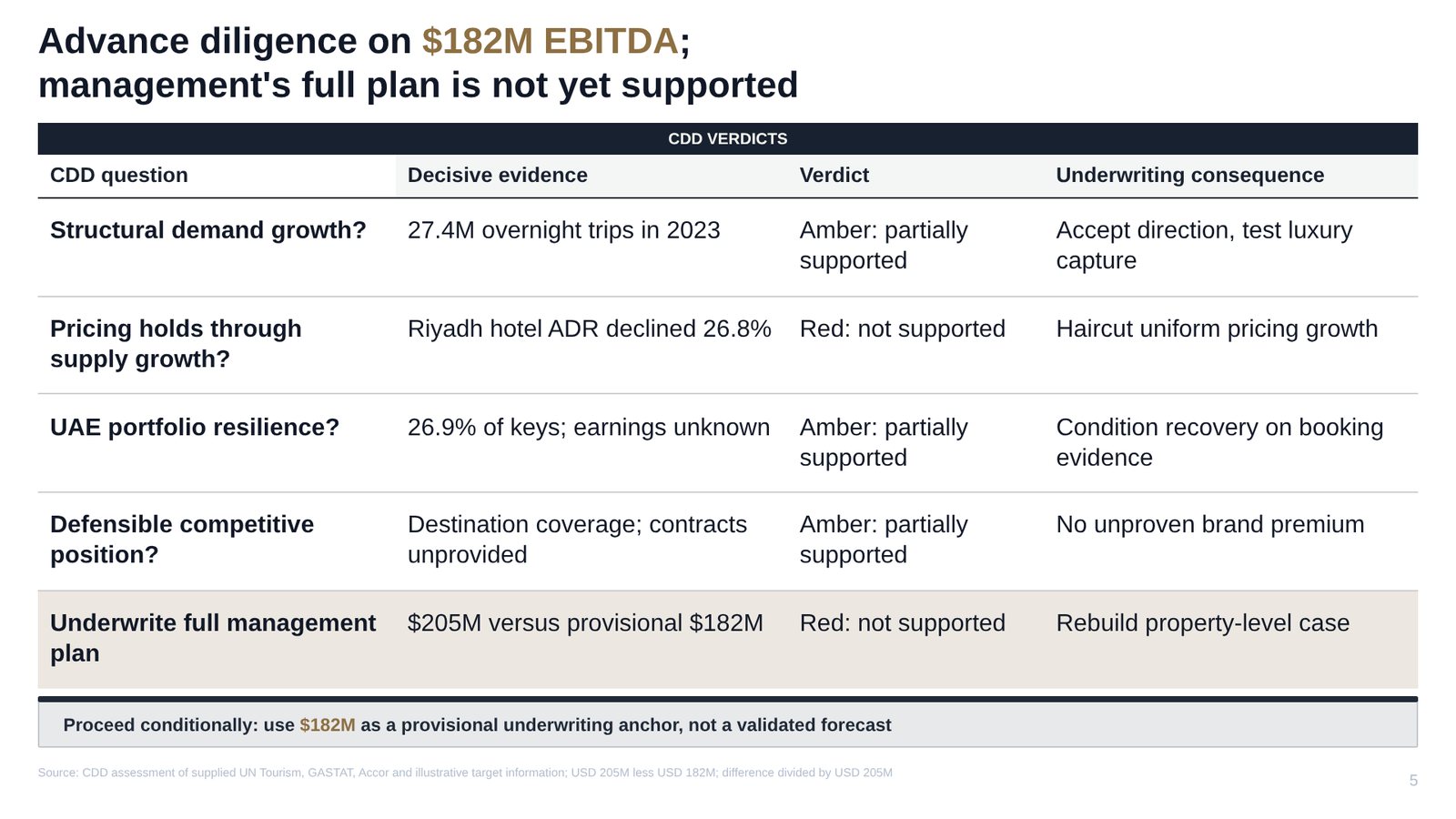
- A verdict table up front: each diligence question answered “supported”, “partially supported” or “not supported”.
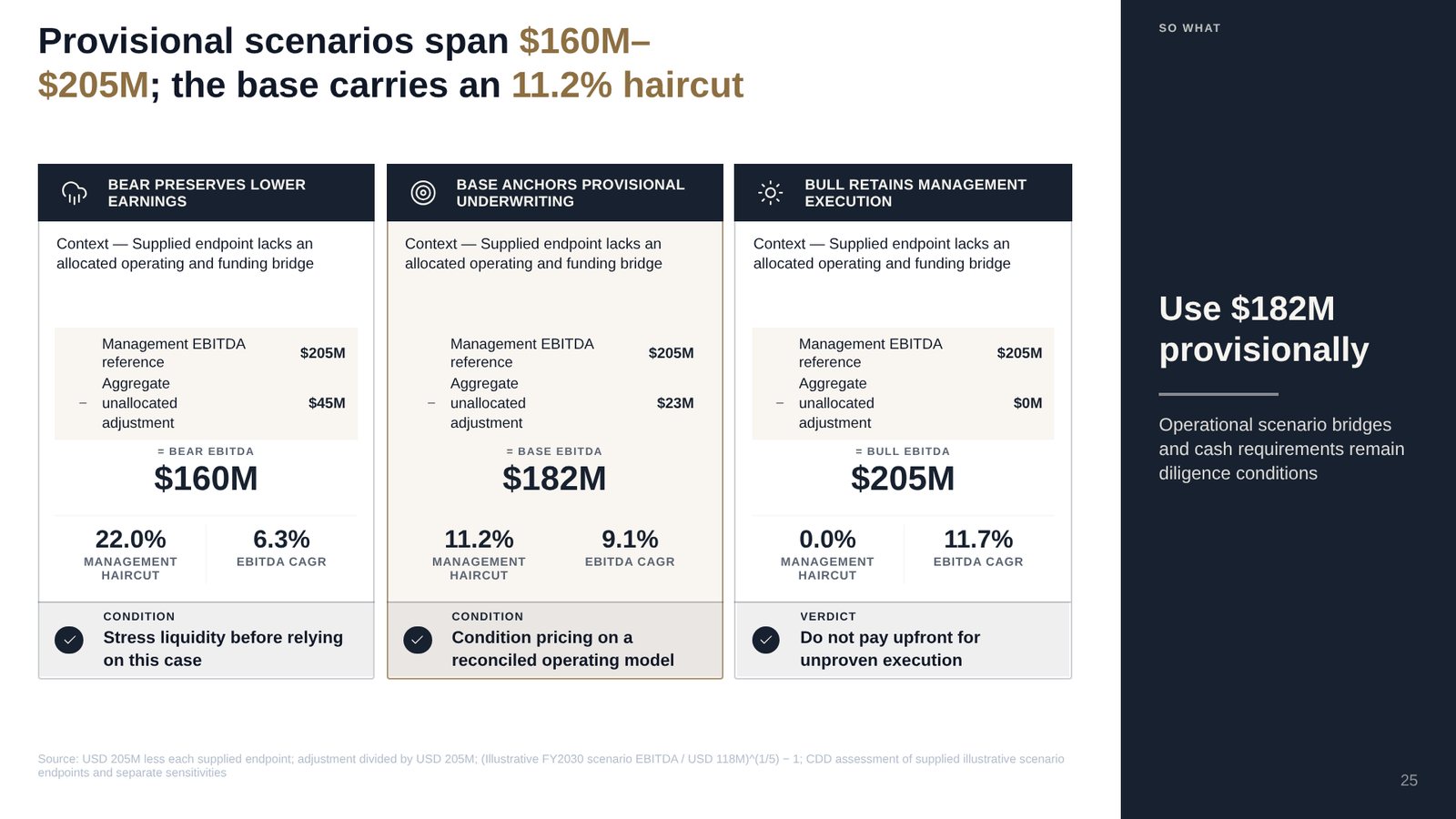
- The plan is haircut to a provisional $182M case instead of being repeated, with the reasons shown.
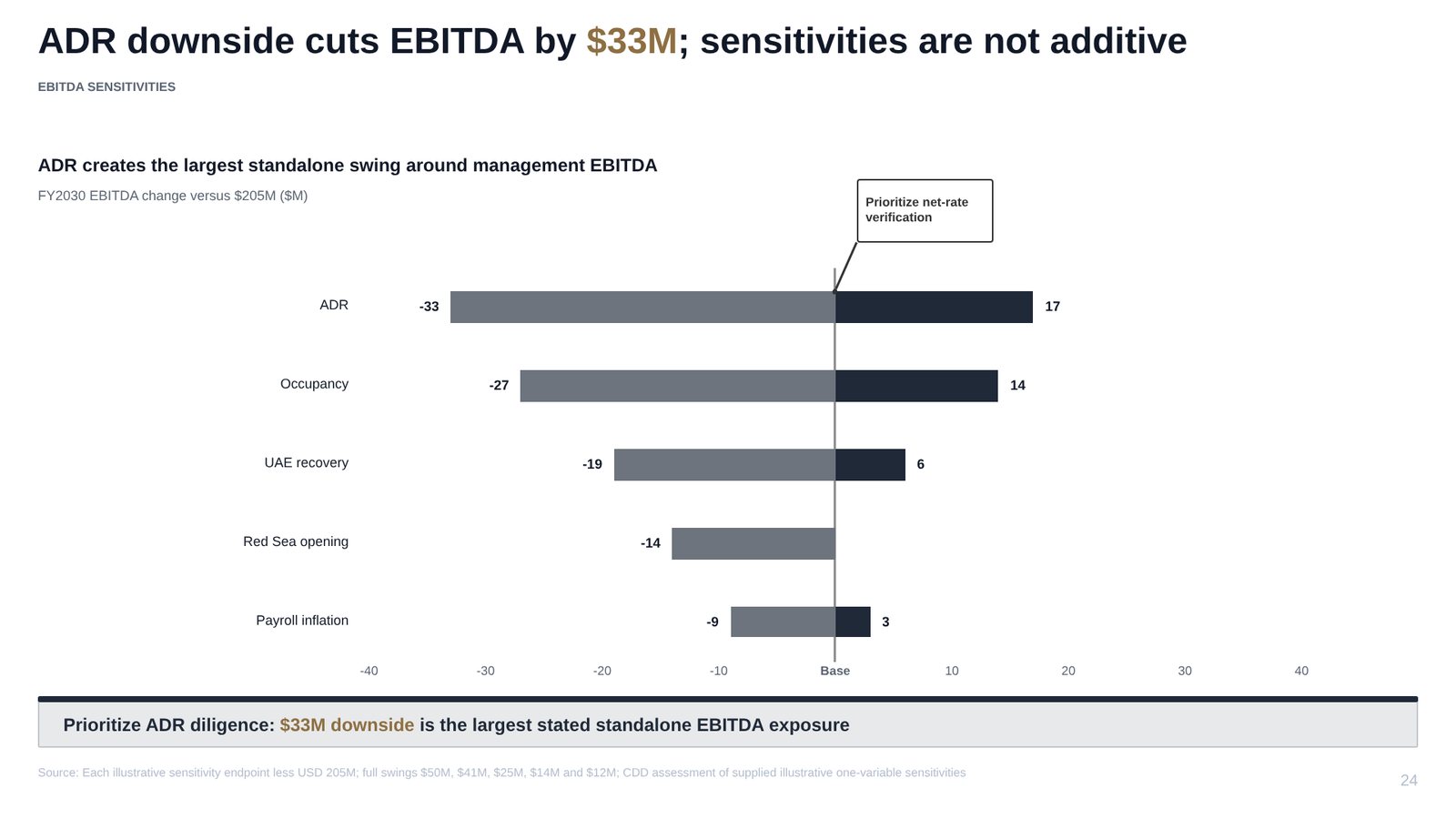
- A tornado chart and three scenarios make clear which assumptions move EBITDA most.
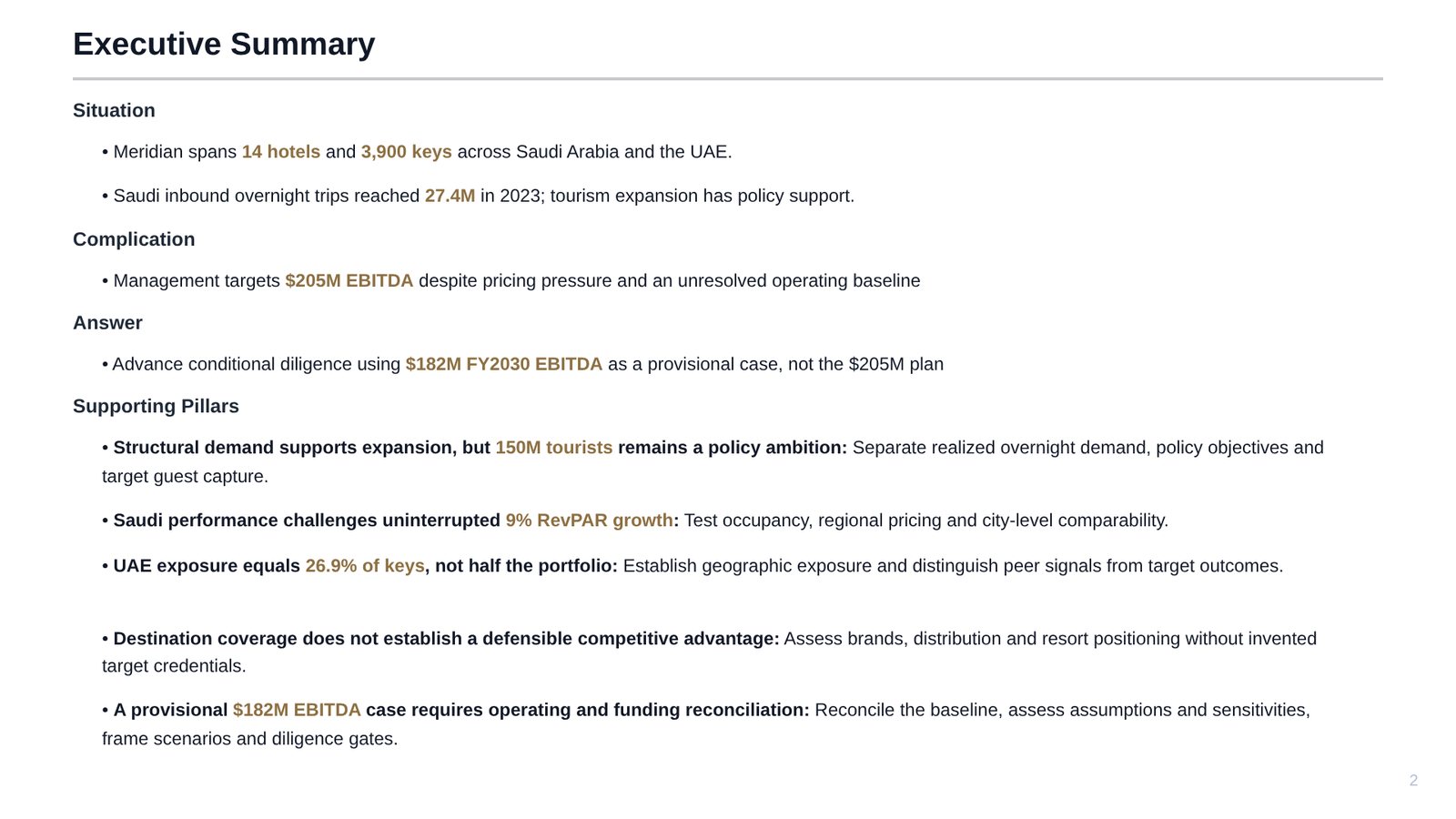
The executive summary
Written in SCQA order: the situation, what complicates it, the answer, then the pillars the rest of the deck proves.
- Situation
Meridian spans 14 hotels and 3,900 keys across Saudi Arabia and the UAE.
Saudi inbound overnight trips reached 27.4M in 2023; tourism expansion has policy support.
- Complication
Management targets $205M EBITDA despite pricing pressure and an unresolved operating baseline
- Answer
Advance conditional diligence using $182M FY2030 EBITDA as a provisional case, not the $205M plan
- Supporting pillars
- Structural demand supports expansion, but 150M tourists remains a policy ambition
- Saudi performance challenges uninterrupted 9% RevPAR growth
- UAE exposure equals 26.9% of keys, not half the portfolio
- Destination coverage does not establish a defensible competitive advantage
- A provisional $182M EBITDA case requires operating and funding reconciliation
The storyline, title by title
Every slide title in the deck, in order. Each one is a full-sentence claim, so the titles alone tell the story.
Demand and Capture
Realized overnight demand supports the opportunity. Policy targets and guest growth do not establish luxury room-night capture or pricing.
- Advance diligence on $182M EBITDA; management's full plan is not yet supported
- Saudi overnight trips grew 11.8% annually through 2023; 2024 remains unverified
- 150M tourists is policy ambition, not guaranteed luxury-hotel demand
- Saudi domestic guests represent 44%; resilience requires booking-level evidence
Pricing and Supply
National occupancy and regional hotel pricing weaken the scarcity argument. Underwriting needs matched property and competitor evidence.
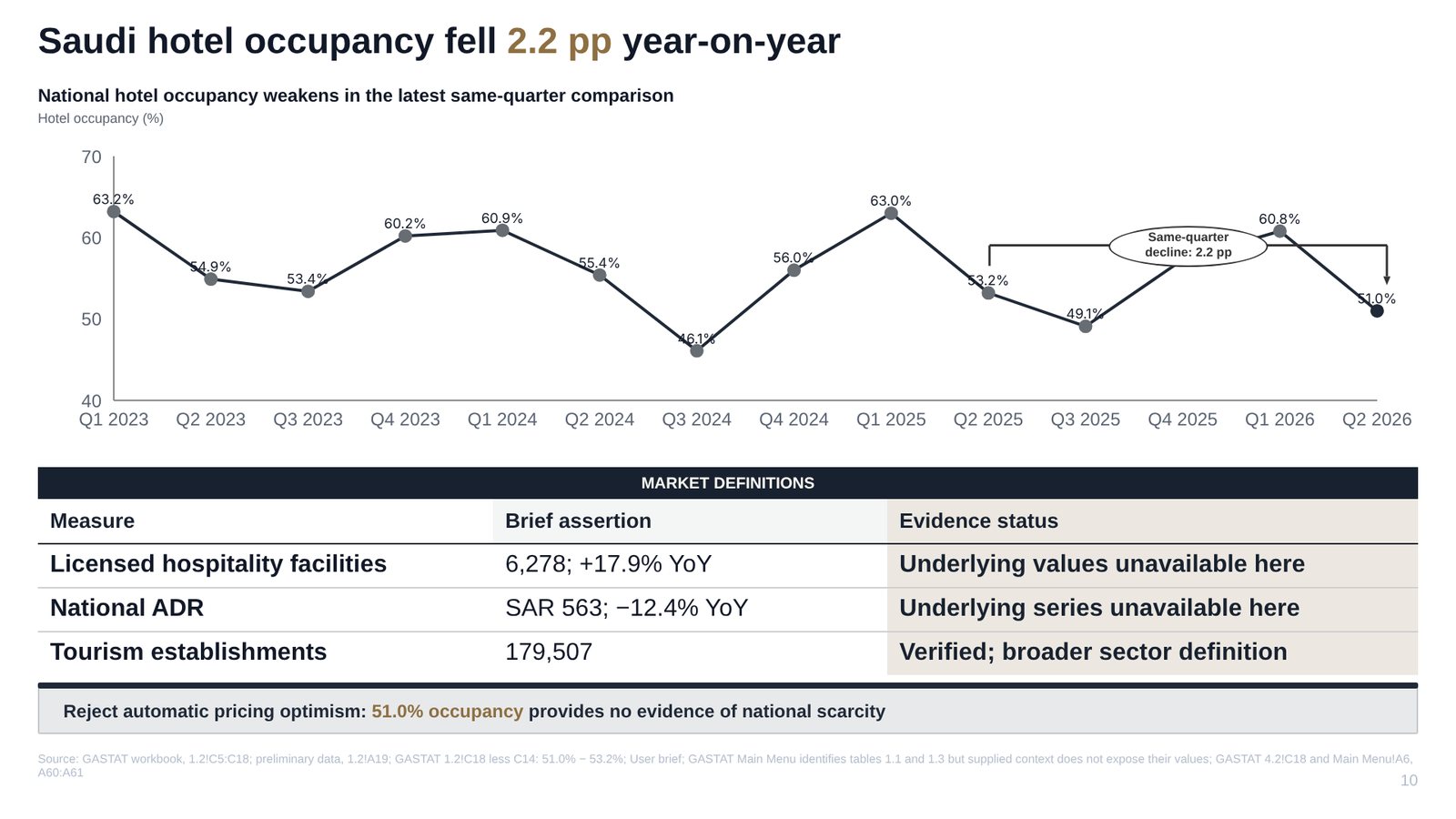
- Saudi hotel occupancy fell 2.2 pp year-on-year
- Riyadh hotel occupancy and ADR imply 40.0% lower RevPAR
- City ADR differs materially; luxury positioning remains unproven
Exposure and Recovery
Physical exposure can be measured; earnings exposure cannot yet be allocated. Peer disruption signals do not establish Meridian's recovery path.
- UAE represents 26.9% of keys, not half
- Accor flags UAE disruption; Q1 2027 recovery remains unproven
- Urban destinations require distinct booking and resilience tests
Competitive Defensibility
Locations may create opportunity, but contracts, distribution economics and relative performance determine whether that opportunity is defensible.
- Destination coverage does not establish a brand or distribution moat
- Red Sea expansion concentrates 800 keys in an unproven resort proposition
Underwriting and Gates
The baseline needs reconciliation before growth is compounded. Scenario endpoints remain provisional until their operating assumptions and cash requirements are explicit.
- FY2025 rooms revenue shows a $28.8M reconciliation gap
- 9% annual RevPAR growth requires pricing or mix—not occupancy alone
- Accept demand direction; haircut growth and condition recovery, openings and costs
- ADR downside cuts EBITDA by $33M; sensitivities are not additive
- Provisional scenarios span $160M–$205M; the base carries an 11.2% haircut
- Condition the 60% investment on reconciled earnings, funded delivery and proven commercial advantages
- Condition the 60% investment on reconciled earnings and funded delivery
The company at the centre of this deck is fictional, and figures marked illustrative in the deck are made up for the example. Public figures come from the sources listed on the deck’s Figures & Assumptions pages, which Whyston adds to every deck.